
Can Chronic Kidney Disease Be Reversed? How Traditional Chinese Medicine May Help Improve Kidney Function and Delay the Risk of Dialysis
Does Chronic Kidney Disease Always Lead to Dialysis? Is There Still a Chance for Kidney Function to Improve?
When many people hear the term “chronic kidney disease,” the first image that comes to mind is the possibility of needing dialysis in the future. In fact, not all patients with chronic kidney disease will rapidly progress to the dialysis stage.
For some patients, if blood sugar, blood pressure, body weight, and diet can be controlled early, and appropriate traditional Chinese medicine care is added, there may be a chance to keep kidney function stable, or even see improvement in certain indicators.
In recent years, more studies have begun to focus on the supportive effects of traditional Chinese medicine(TCM)for chronic kidney disease(CKD), including:
- Reducing chronic kidney inflammation
- Delaying renal fibrosis
- Improving proteinuria
- Preserving residual kidney function
- Slowing the rate of deterioration caused by chronic diseases
Chronic Kidney Disease Case Studies: Kidney Function Improved After TCM Care
Case 1: Declining Kidney Function Caused by Obesity and a High-Protein Diet
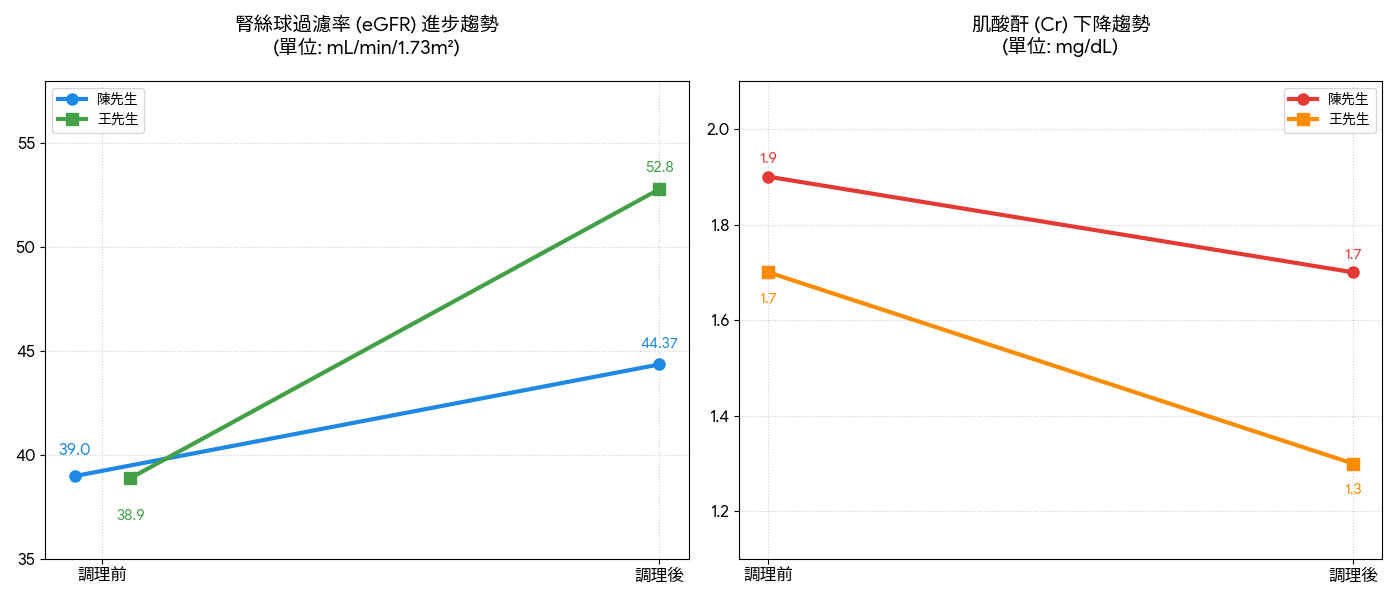
Mr. Chen, in his 50s, usually preferred a meat-heavy diet. His BMI was over 30, and he lacked regular exercise. When he sought medical care, he was already in stage 3 chronic kidney disease.
Initial test results:
- Creatinine: 1.9 mg/dL
- Estimated glomerular filtration rate(eGFR): 39 mL/min/1.73m²
After approximately 3 months of TCM care, along with dietary and lifestyle adjustments:
- Creatinine decreased to 1.7 mg/dL
- eGFR increased to 44.37 mL/min/1.73m²
Case 2: Elderly Patient With Multiple Chronic Diseases and Kidney Function Decline
Mr. Wang, in his 80s, had several underlying conditions, including:
- Hypertension
- Hyperlipidemia
- Heart failure
- Stroke
- Mild dementia
At the initial visit:
- Creatinine: 1.7 mg/dL
- eGFR: 38.9 mL/min/1.73m²
After several months of treatment:
- Creatinine decreased to 1.3 mg/dL
- eGFR improved to 52.8 mL/min/1.73m²
Why Is Chronic Kidney Disease Becoming More Common?
According to statistics, approximately 1 in 8 people in Taiwan has chronic kidney disease, but more than 90% of patients are unaware that they have the condition.
The reasons include:
- Early symptoms are not obvious
- The kidneys have a strong compensatory ability
- Many patients only notice the problem after fatigue, swelling, or foamy urine appears
When kidney function continues to decline, it may further lead to:
- Electrolyte imbalance
- Hypertension
- Cardiovascular disease
- Anemia
- Bone problems
- Increased risk of dialysis
How Does Traditional Chinese Medicine View Chronic Kidney Disease?
From the perspective of traditional Chinese medicine:
“The spleen is the foundation of acquired constitution, while the kidney is the foundation of innate constitution.”
The spleen and stomach are responsible for transforming and transporting nutrition, qi, and blood, while the kidneys govern water metabolism and the storage of vital energy. Therefore, the spleen and kidneys often influence each other.
Clinically, patients with chronic kidney disease commonly present with:
- Spleen deficiency with dampness accumulation
- Qi deficiency with edema
- Kidney deficiency with blood stasis
- A chronic inflammatory constitution
Therefore, treatment directions often include:
Strengthening the Spleen and Resolving Dampness
Improving metabolism and gastrointestinal absorption, while reducing sources of chronic inflammation.
Activating Blood Circulation and Resolving Stasis
Some studies suggest that this may help reduce renal fibrosis and microcirculatory dysfunction.
Promoting Water Metabolism and Reducing Edema
Improving abnormal fluid metabolism and swelling in the lower limbs.
Supporting Vital Qi and Strengthening the Foundation
Enhancing immunity and reducing kidney function deterioration caused by infections.
Which Chinese Herbs Have Been Studied for Kidney Protection?
In recent years, commonly discussed Chinese herbs in related studies include:
- Astragalus
- Salvia miltiorrhiza
- Cuscuta seed
- Epimedium
- Goji berry
- Rhubarb
Among them, “Astragalus” is one of the core herbs most frequently mentioned in current research.
Research directions include:
- Anti-inflammatory effects
- Antioxidant effects
- Reducing renal fibrosis
- Preserving residual kidney function
However, it should still be emphasized that:
Chinese herbal medicine does not make damaged kidneys grow back; rather, it may help slow the rate of deterioration.
Therefore, patients with chronic kidney disease should still regularly monitor:
- eGFR
- Creatinine
- Urine protein
- Blood pressure
- Blood sugar
Daily Care Tips for Patients With Chronic Kidney Disease
Control Blood Sugar and Blood Pressure
Diabetes and hypertension are the main causes of kidney failure.
Reduce Processed Foods and High-Salt Diets
Excess sodium increases the burden on the kidneys.
Maintain Regular Exercise
Regular exercise can improve metabolism and cardiovascular circulation.
Avoid Taking Unknown Herbs or Unverified Chinese Medicines
Some herbs or herbal products may contain:
- Aristolochic acid
- Heavy metals
- Nephrotoxic ingredients
These may instead accelerate kidney function deterioration.
Regular Blood and Urine Tests
Many cases of kidney function decline do not cause obvious symptoms, so regular testing is very important.
Is Traditional Chinese Medicine Useful for Chronic Kidney Disease?
Current medical evidence suggests that:
- Traditional Chinese medicine can serve as a supportive treatment
- It may help slow deterioration
- It may improve certain symptoms and quality of life
- Patients should not stop Western medication on their own
The real key still lies in:
- Managing chronic diseases
- Regular follow-up
- Dietary management
- Lifestyle adjustment
The kidneys are not organs that easily “cry out” in pain. They are more like a filtering machine that works silently. Many people still feel no obvious symptoms even when kidney function has already dropped by half.
The earlier the intervention, the greater the chance of preserving kidney function.
References
- National Kidney Foundation. Chronic Kidney Disease Overview
- KDIGO Clinical Practice Guideline for CKD Evaluation and Management
- Astragalus-based traditional medicine and renal protection studies
- Journal of Ethnopharmacology: Chinese herbal medicine in CKD
- Taiwan Society of Nephrology Guidelines