
Source: Liberty Times / Liberty Times Health
Original Article: 慢性腎臟病搭配中醫 延後透析
Publication Date: February 12, 2023
By Kao Hao-Yu
Original Liberty Times Article
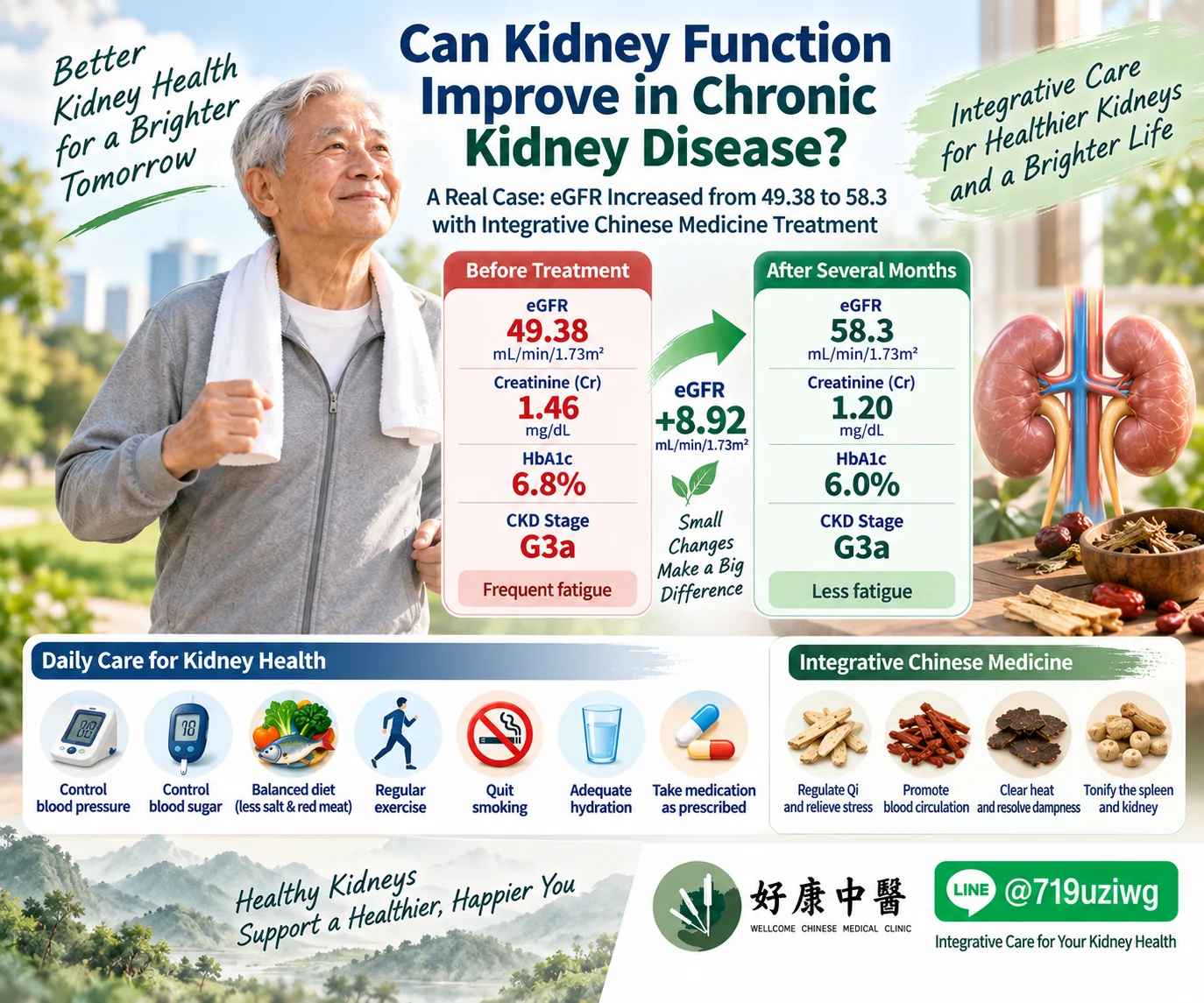
Mr. Chen, an 80-year-old man, had hypertension, hyperlipidemia, cardiac arrhythmia, and Stage 3 chronic kidney disease. At his initial visit, his serum creatinine was 1.46 mg/dL, his estimated glomerular filtration rate (eGFR) was 49.38 mL/min/1.73 m², and his HbA1c was 6.8%. He also frequently experienced fatigue.
After several months of Traditional Chinese Medicine treatment, his serum creatinine improved to 1.2 mg/dL, his eGFR increased to 58.3 mL/min/1.73 m², and his HbA1c decreased to 6.0%. His fatigue also improved.
Common Causes Include Hypertension and Diabetes
Chronic kidney disease has many possible causes, with hypertension and diabetes among the most common.
Diabetic microvascular disease can lead to proteinuria and progressive kidney function decline. Long-standing hypertension can contribute to arterial damage and kidney injury. The original article also emphasized that chronic kidney disease, including nephritis, nephrotic syndrome, and chronic renal impairment, should not be overlooked.
From the perspective of Traditional Chinese Medicine, chronic kidney disease may fall within traditional categories such as “edema” (水腫), “wasting-thirst” (消渴), and “oily or turbid urine” (小便如膏).
The kidney is considered the primary organ involved, while the spleen and stomach may also play an important role. The heart, liver, and lungs may also be involved depending on the patient’s condition.
Early Stage
In the early stage, the condition may be associated with external pathogenic factors and stagnation of Liver Qi.
Treatment may therefore focus on:
- Releasing the exterior and dispelling wind
- Soothing the Liver and regulating Qi
- Keeping warm to reduce the risk of infection
- Managing emotional stress appropriately
Middle Stage
In the middle stage, TCM patterns may include:
- Accumulation of damp-heat
- Blood stasis obstructing the collaterals
- Retention of pathogenic factors
Lifestyle management may include regular physical activity, appropriate hydration according to the patient’s condition, and reducing excessive intake of red meat, refined sugars, and high-sodium foods.
Fish and lighter, less processed foods may be chosen more often as appropriate.
Advanced Stage
In the advanced stage, deficiency of the Spleen and Kidney may become more prominent.
Treatment principles may focus on strengthening the Spleen and Kidney according to the patient’s individual condition, with the aim of supporting overall function and reducing physiologic stress.
The original article also cited analyses using Taiwan’s National Health Insurance Research Database that reported associations between Chinese medicine use and lower dialysis or mortality rates in some groups of patients with kidney disease.
Because these are observational database studies, however, they can show associations but do not by themselves prove that Chinese medicine directly prevents dialysis or reduces mortality.
In addition to integrative Chinese and Western medical care, patients with chronic kidney disease should monitor blood pressure, pay attention to body weight, take medications as prescribed, and stop smoking.
Lifestyle measures may also include reducing alcohol intake, choosing healthier foods, limiting excess sodium, and exercising regularly.
(The author was an attending physician in the Department of Chinese Medicine at MacKay Memorial Hospital at the time of publication.)
Q1: What Was the Patient’s Kidney Function at the Beginning?
Mr. Chen’s initial kidney function was:
- eGFR: 49.38 mL/min/1.73 m²
- Creatinine (Cr): 1.46 mg/dL
An eGFR of 49.38 falls within the G3a range (45–59 mL/min/1.73 m²).
Because the patient also had hypertension, hyperlipidemia, and cardiac arrhythmia, management of these chronic conditions remained important alongside kidney function monitoring.
Q2: How Much Did His Kidney Function Improve After Several Months?
The follow-up results reported in the original article were:
| Indicator | Before Treatment | Several Months Later | Change |
|---|---|---|---|
| eGFR | 49.38 | 58.3 | +8.92 |
| Creatinine (Cr) | 1.46 | 1.20 | −0.26 |
| HbA1c | 6.8% | 6.0% | −0.8% |
| eGFR Category | G3a | G3a | No category change |
| Fatigue | Frequent fatigue | Improved | — |
Net increase in eGFR: +8.92 mL/min/1.73 m²
Q3: Does an Increase in eGFR from 49.38 to 58.3 Mean That Stage 3 Improved to Stage 2?
Not yet.
Both an eGFR of 49.38 and 58.3 fall within the G3a range (45–59 mL/min/1.73 m²).
A more accurate description is:
“During follow-up, eGFR increased from 49.38 to 58.3 mL/min/1.73 m², showing improvement in kidney function measurements, while the eGFR category remained G3a.”
If a future eGFR reaches 60 or higher, it would enter the G2 range. However, even then, a single eGFR result would not be enough to conclude that chronic kidney disease had been completely cured.
Q4: Why Is Blood Pressure and Blood Glucose Control Important in CKD?
Hypertension and diabetes are major contributors to chronic kidney disease.
Diabetes-related microvascular damage can lead to proteinuria and kidney function decline, while long-standing hypertension can damage blood vessels and increase stress on the kidneys.
In this case, the patient’s HbA1c decreased from 6.8% to 6.0% during follow-up, alongside improvements in eGFR and serum creatinine.
However, because several clinical values changed at the same time, the improvement cannot be attributed to any single treatment alone.
Patients with CKD should continue to manage blood pressure, blood glucose, blood lipids, and other kidney-related risk factors.
Q5: Can Chronic Kidney Disease Be Treated with Integrative Chinese Medicine?
The original article discusses chronic kidney disease through traditional TCM concepts such as edema, wasting-thirst, and abnormal turbid urine, and describes different treatment principles according to the stage of disease and the patient’s individual pattern.
These may include:
- Releasing the exterior and dispelling wind
- Soothing the Liver and regulating Qi
- Addressing damp-heat and blood stasis
- Strengthening the Spleen and Kidney in later stages
For patients who wish to combine Chinese and Western medical care, treatment should still be individualized according to:
- eGFR
- Proteinuria or albuminuria
- Serum potassium
- Blood pressure
- Blood glucose
- Current Western medications
- Overall clinical condition
Patients with impaired kidney function should not self-prescribe Chinese herbal medicine or supplements.
Q6: Does a Higher eGFR Mean That Chronic Kidney Disease Is Cured?
Not necessarily.
eGFR is influenced by serum creatinine and other physiologic factors, so long-term trends are more important than a single measurement.
Clinicians may also evaluate:
- Proteinuria or albuminuria
- Serum creatinine
- Blood pressure
- Blood glucose
- Potassium and other electrolytes
- Other markers of kidney damage
In this case, the follow-up results were:
eGFR: 49.38 → 58.3
Creatinine: 1.46 → 1.20 mg/dL
HbA1c: 6.8% → 6.0%
eGFR Category: G3a → G3a
Therefore, the most appropriate description is:
“Kidney function measurements improved during follow-up in a patient with Stage 3a CKD, while the eGFR category remained G3a.”
It should not be described as a transition from Stage 3 to Stage 2.
This is an individual patient’s follow-up outcome and does not mean that every patient with chronic kidney disease will experience the same degree of improvement with the same treatment.