
Source: Liberty Times / Liberty Times Health
Original Article: 85歲翁怕洗腎 中醫對症解困擾
Publication Date: March 14, 2021
Original Article: Liberty Times Health
By Kao Hao-Yu
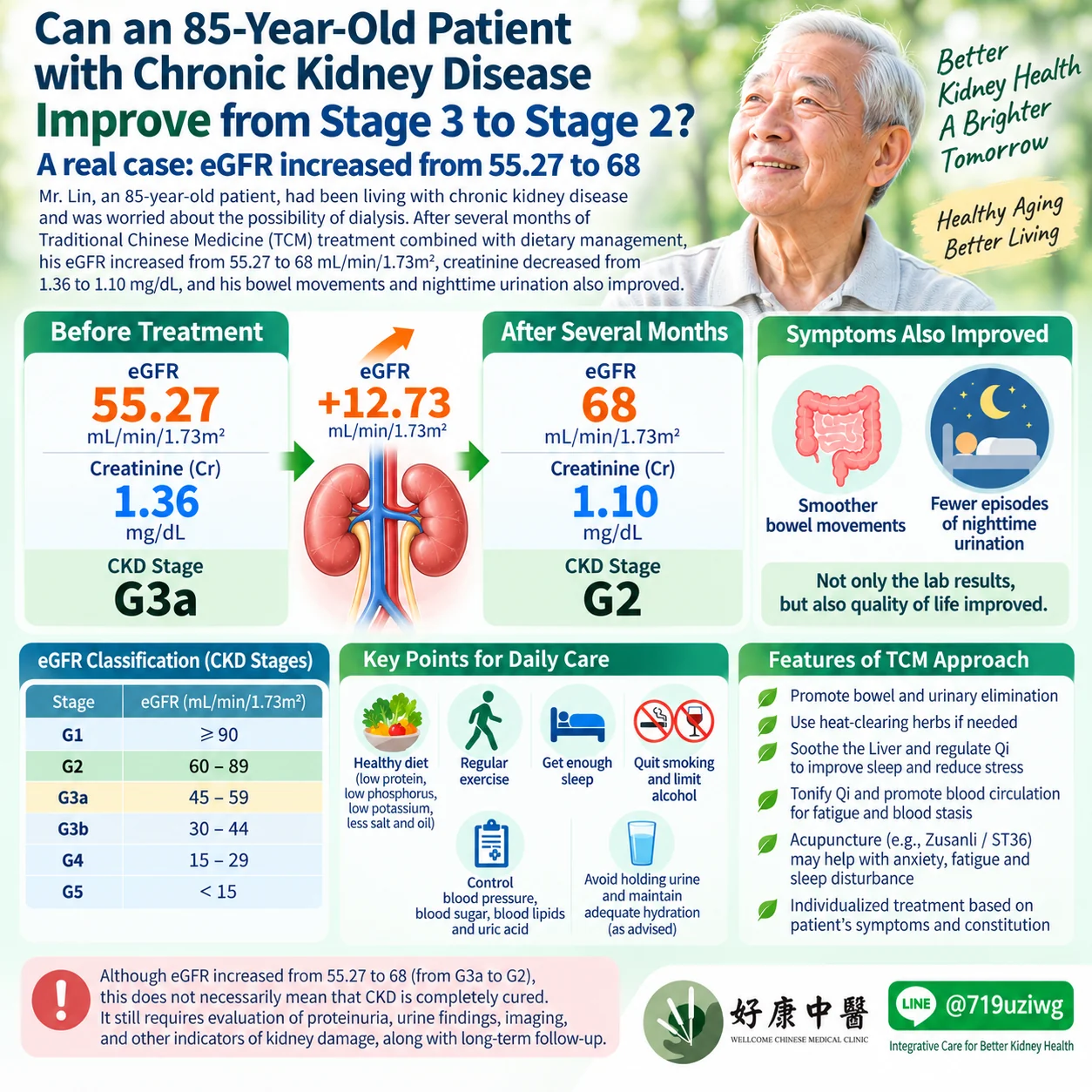
Mr. Lin, an 85-year-old patient, had been living with chronic kidney disease for many years and was concerned that he might eventually require dialysis.
After several months of Traditional Chinese Medicine (TCM) treatment combined with dietary management, his estimated glomerular filtration rate (eGFR) increased from 55.27 to 68 mL/min/1.73 m², while his serum creatinine decreased from 1.36 to 1.10 mg/dL. After treatment, he also reported smoother bowel movements and fewer episodes of nighttime urination.
Chronic kidney disease can have many causes. When eGFR is above 60 mL/min/1.73 m², patients may have few or no obvious symptoms. As kidney function declines, some patients may develop symptoms such as foamy urine, edema, hypertension, fatigue, and anemia.
From a Traditional Chinese Medicine perspective, clinical manifestations of chronic kidney disease may be discussed within traditional concepts such as “edema” (水腫), “kidney taxation” (腎勞), and “kidney deficiency” (腎虛).
Treatment is individualized according to the patient’s symptoms and TCM pattern differentiation.
One treatment principle described in the original article is to promote bowel and urinary elimination. For patients who tend to show signs of internal heat, heat-clearing and detoxifying herbs may be considered according to their individual condition.
For patients experiencing poor sleep or emotional tension, TCM approaches that soothe the Liver and regulate Qi may be used to improve sleep and help regulate autonomic nervous system activity.
When prolonged illness is accompanied by deficiency and blood stasis, Qi-tonifying approaches may be used for fatigue, while blood-activating and stasis-resolving methods may be considered to promote circulation.
For patients with poorer cardiac function and shortness of breath, treatment may also take cardiovascular symptoms into account. For patients with obesity, dietary management, exercise, and individualized approaches to dampness and phlegm may be incorporated to help manage metabolic risk factors.
Acupuncture and CKD-Related Symptoms
The original article also discusses acupuncture as an adjunctive treatment for symptoms such as anxiety, fatigue, and sleep disturbance, with Zusanli (ST36) mentioned as an example of an acupuncture point used clinically.
The article further cites research using Taiwan’s National Health Insurance Research Database that examined associations between Chinese herbal medicine use and dialysis outcomes among patients with chronic kidney disease.
Because such database studies are observational, however, they can identify associations rather than prove that Chinese herbal medicine itself prevents dialysis.
Exercise Regularly, Avoid Staying Up Late, and Manage Chronic Diseases
In addition to appropriate Western and Chinese medical care, patients with chronic kidney disease should maintain healthy lifestyle habits.
These may include regular physical activity, adequate sleep, avoiding prolonged urine retention, smoking cessation, limiting excessive alcohol consumption, and actively managing hypertension, diabetes, dyslipidemia, and uric acid levels.
Dietary recommendations should be individualized according to CKD stage, laboratory results, nutritional status, and whether the patient is receiving dialysis. Protein, phosphorus, potassium, sodium, and fluid intake should therefore be adjusted with professional guidance rather than applying the same restrictions to every patient.
(The author was an attending physician in the Department of Chinese Medicine at MacKay Memorial Hospital at the time of publication.)
Q1: What was the patient’s kidney function before treatment?
The 85-year-old patient initially had:
- eGFR: 55.27 mL/min/1.73 m²
- Creatinine (Cr): 1.36 mg/dL
An eGFR of 55.27 falls within the G3a range.
Q2: How did his kidney function change after several months?
After several months of follow-up:
- eGFR: 55.27 → 68 mL/min/1.73 m²
- Creatinine: 1.36 → 1.10 mg/dL
The original article also reported improvements in bowel movements and nighttime urination.
Kidney Function Before and After Treatment
| Indicator | Before Treatment | Follow-Up |
|---|---|---|
| eGFR | 55.27 | 68 |
| Creatinine (Cr) | 1.36 | 1.10 |
| GFR Category | G3a | G2 |
Net increase in eGFR: +12.73 mL/min/1.73 m²
Q3: Can we say that his kidney function improved from Stage 3 to Stage 2?
In terms of the eGFR category, the patient’s kidney function moved from the G3a range to the G2 range.
His initial eGFR of 55.27 was within G3a, while the follow-up value of 68 was within G2.
However, this does not necessarily mean that chronic kidney disease itself has disappeared or been cured.
CKD diagnosis and assessment are not based on a single eGFR measurement alone. Clinicians also consider whether abnormalities have persisted for more than three months and whether other markers of kidney damage are present, such as:
- Albuminuria or proteinuria
- Abnormal urinary findings
- Structural abnormalities of the kidneys
- Imaging abnormalities
- Other evidence of persistent kidney damage