
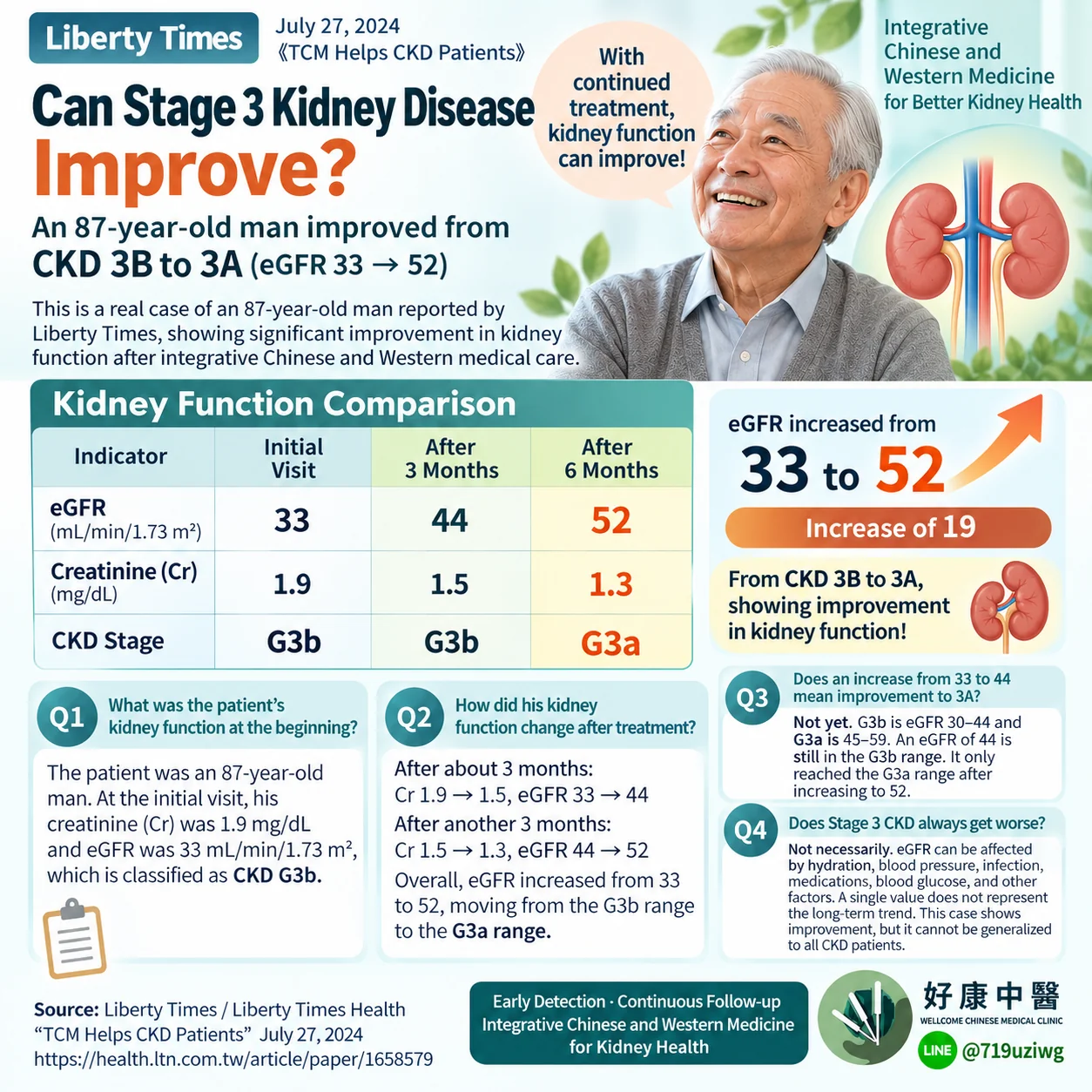
Article 1 | Can Kidney Function Improve in CKD Stage 3B? A Follow-Up Case of eGFR Increasing from 33 to 52

Source: Liberty Times / Liberty Times Health (自由時報/自由健康網)
Original Article: 慢性腎臟病友 中醫診療神助攻
Publication Date: July 27, 2024
Original Article: Liberty Times

By Kao Hao-Yu

“Doctor, thank you for helping my chronic kidney disease improve to Stage 3!”

Mr. Lin, an 87-year-old man, had long been troubled by multiple chronic health conditions. Although he did not have hypertension or diabetes, he had chronic kidney disease (CKD), chronic obstructive pulmonary disease (COPD), sequelae of cerebral infarction, and hyperuricemia. He also experienced nasal congestion, dry mouth upon waking, excessive skin flaking, fatigue, and nocturia three to four times every night.

At his first visit, Mr. Lin’s serum creatinine level was 1.9 mg/dL, and his estimated glomerular filtration rate (eGFR) was only 33 mL/min/1.73 m². After three months of Chinese medicine treatment, his creatinine decreased to 1.5 mg/dL, while his eGFR increased to 44 mL/min/1.73 m². After another three months of continued treatment, his creatinine further decreased to 1.3 mg/dL, and his eGFR increased to 52 mL/min/1.73 m².

Although the frequency of his nocturia did not decrease substantially, Mr. Lin showed significant improvement in kidney function, while his fatigue and skin condition also improved.

One in every eight adults in Taiwan has kidney disease, and the prevalence of chronic kidney disease among adults aged 20 and older has exceeded 12%. In addition, more than 90% (96%) of patients with early-stage kidney disease are unaware that they have the condition.

According to dialysis data from 2007, the three leading causes of dialysis in Taiwan were diabetes (43.2%), glomerulonephritis (25.1%), and hypertension (8.3%).

Secondary glomerulonephritis, such as nephritis associated with systemic lupus erythematosus or malignancy, and autosomal dominant polycystic kidney disease may also lead to declining kidney function. Long-term urinary tract obstruction caused by conditions such as urinary stones or an enlarged prostate may also contribute to kidney function decline. In addition, prolonged excessive use of pain medications may worsen kidney function.

From the perspective of Western medicine, the treatment strategy focuses on achieving good control of underlying chronic diseases. Sodium-glucose cotransporter-2 inhibitors (SGLT2 inhibitors) may be used to promote urinary glucose excretion and provide kidney-protective effects. For patients with proteinuria, angiotensin-converting enzyme inhibitors (ACE inhibitors) or angiotensin II receptor blockers (ARBs) may also be considered.

Qi-Tonifying and Blood-Activating Chinese Herbal Medicine to Promote Circulation and Reduce Fibrosis

Chronic kidney disease does not have an identical disease name in classical Chinese medical literature. However, its clinical manifestations may correspond to traditional concepts such as Guan Ge (關格, difficulty in urination), edema, and Xu Lao (虛勞, deficiency-related weakness).

During the acute stage, treatment should focus on addressing the precipitating cause. For example, when an acute cold or infection is involved, Jing Jie (荊芥, Schizonepeta) may be used to release the exterior, Bai Zhu (白朮, Atractylodes macrocephala) to promote fluid metabolism, and Bai Mao Gen (白茅根, Imperata cylindrica rhizome) to clear heat and promote urination.

In patients with chronic disease, the underlying constitution is often characterized by deficiency accompanied by blood stasis. Chinese herbal medicines that tonify Qi and promote blood circulation may therefore be used to improve renal circulation and reduce inflammation and fibrosis.

In addition to integrating Chinese and Western medical treatment, patients should maintain adequate daily hydration, reduce excessive oil, salt, and sugar intake, limit processed foods, exercise regularly, get sufficient sleep, and maintain a positive emotional state. Together, these measures may help support the improvement of kidney health.

(The author, Dr. Kao Hao-Yu, was an attending physician in the Department of Chinese Medicine at MacKay Memorial Hospital at the time of publication.)

Q1: What was the patient’s kidney function at the beginning?

This case involved an 87-year-old man. At his initial visit, his serum creatinine (Cr) was 1.9 mg/dL, and his eGFR was 33 mL/min/1.73 m², placing his kidney function in the CKD G3b range.

Q2: How did his kidney function change after treatment?

After approximately 3 months of treatment:

  • Cr: 1.9 → 1.5 mg/dL
  • eGFR: 33 → 44 mL/min/1.73 m²

After another approximately 3 months of continued treatment:

  • Cr: 1.5 → 1.3 mg/dL
  • eGFR: 44 → 52 mL/min/1.73 m²

Overall, his eGFR increased from 33 to 52, moving from the G3b range into the G3a range.

Kidney Function Before and After Treatment

Indicator Initial Visit About 3 Months About 6 Months
eGFR 33 44 52
Cr 1.9 1.5 1.3
CKD Stage G3b G3b G3a

Net increase in eGFR: +19 mL/min/1.73 m²

Q3: Does an increase in eGFR from 33 to 44 mean that kidney function improved from G3b to G3a?

Not yet.

CKD G3b corresponds to an eGFR of 30–44 mL/min/1.73 m², while G3a corresponds to an eGFR of 45–59 mL/min/1.73 m².

Therefore, when the patient’s eGFR first increased to 44, it was still within the G3b range. It was only after his eGFR subsequently increased to 52 that his kidney function entered the G3a range.

Q4: Does Stage 3 CKD always continue to get worse?

Not necessarily.

eGFR can be affected by hydration status, blood pressure, infection, medications, blood glucose, and other factors. Therefore, a single eGFR measurement does not necessarily represent the long-term trend in kidney function.

The key point in this case is that, over several months of follow-up, the patient showed both an increase in eGFR and a decrease in serum creatinine.

However, this is an individual clinical case, and the outcome should not be interpreted to mean that every patient with chronic kidney disease will experience the same improvement.

[Wellcome TCM Clinic]

Professional Disease Evaluation & Appointment Booking — Dr. Kao Hao-Yu, TCM Physician

Scroll to Top