
Many people assume that when preparing Chinese herbal medicine, “the longer the herbs are decocted, the more substances will be extracted from them.”
However, when it comes to minerals such as potassium, calcium, and magnesium, the situation may not be that simple.
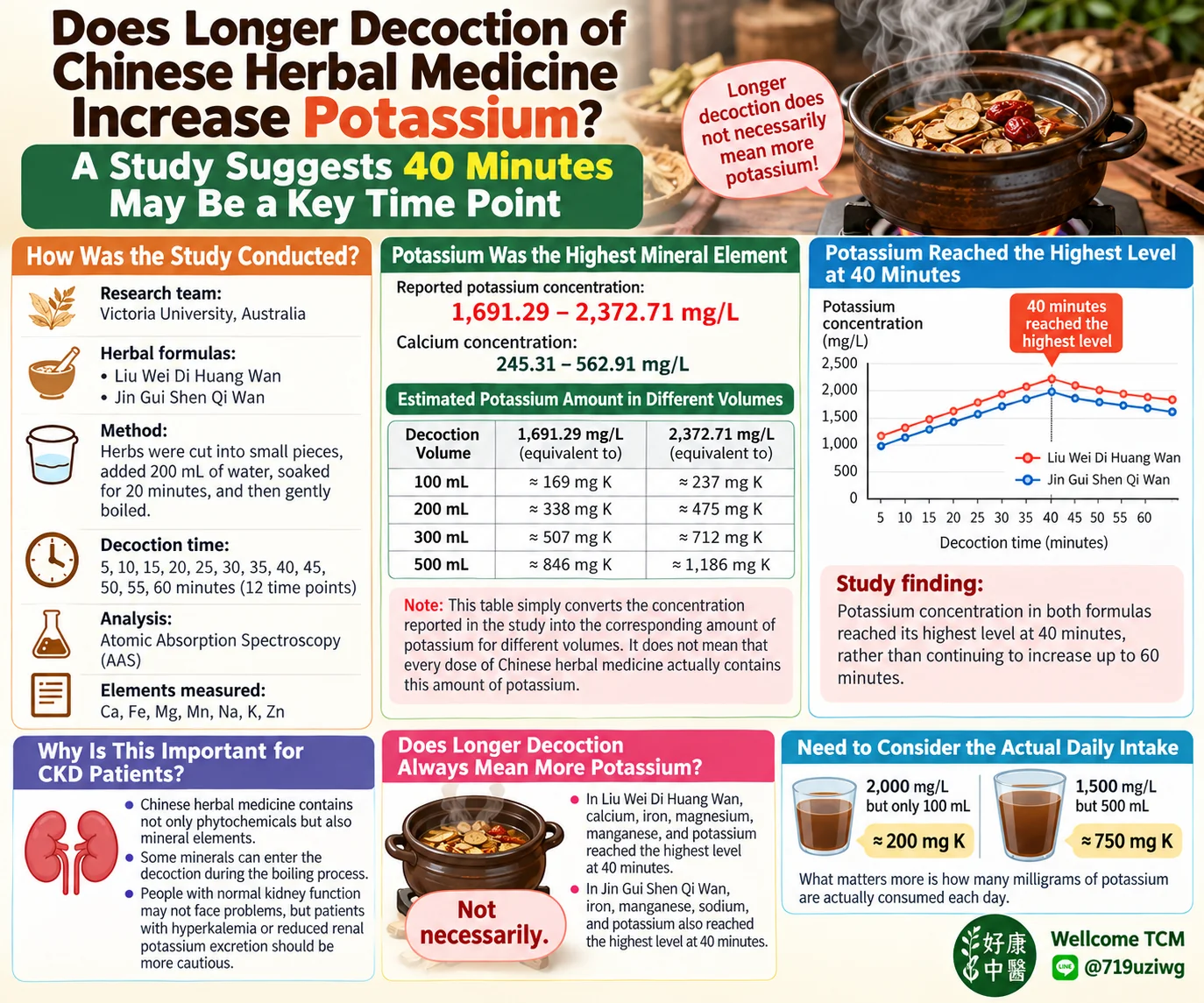
A study on Liu Wei Di Huang Wan and Jin Gui Shen Qi Wan decocted these herbal formulas for different periods ranging from 5 to 60 minutes and analyzed the concentrations of potassium, calcium, magnesium, iron, manganese, sodium, and zinc in the resulting decoctions.
The study found:
Potassium was the mineral present at the highest concentration among the measured elements in both formulas. However, potassium concentration did not continue to increase as decoction time became longer. In both formulas, potassium concentration reached its highest level at 40 minutes.
This finding is particularly worth understanding for patients with chronic kidney disease (CKD) who may need to pay attention to their potassium intake.
How Was the Study Conducted?
This study was conducted by researchers at Victoria University in Australia and examined two commonly used traditional Chinese herbal formulas:
Liu Wei Di Huang Wan
Jin Gui Shen Qi Wan
The researchers cut the herbs into small pieces, added 200 mL of water, soaked them for 20 minutes, and then heated the mixture to boiling while maintaining a gentle boil.
The study used 12 different decoction times:
5, 10, 15, 20, 25, 30, 35, 40, 45, 50, 55, and 60 minutes.
After decoction, the herbal liquids were cooled and filtered. The researchers then used Atomic Absorption Spectroscopy (AAS) to measure the mineral elements in the decoctions.
The elements measured were:
Calcium (Ca), iron (Fe), magnesium (Mg), manganese (Mn), sodium (Na), potassium (K), and zinc (Zn).
Study Finding: Chinese Herbal Decoctions Can Contain Considerable Amounts of Potassium
Among the mineral elements measured in these two Chinese herbal formulas, potassium had the highest concentration.
The reported potassium concentration ranged from:
1,691.29–2,372.71 mg/L.
Calcium had the second-highest concentration, ranging from:
245.31–562.91 mg/L.
Because mg/L may be difficult for the general public to interpret, the potassium concentrations can be converted into approximate amounts for different volumes of herbal decoction:
| Decoction Volume | At 1,691.29 mg/L | At 2,372.71 mg/L |
|---|---|---|
| 100 mL | Approx. 169 mg potassium | Approx. 237 mg potassium |
| 200 mL | Approx. 338 mg potassium | Approx. 475 mg potassium |
| 300 mL | Approx. 507 mg potassium | Approx. 712 mg potassium |
| 500 mL | Approx. 846 mg potassium | Approx. 1,186 mg potassium |
However, it is important to note:
The table above simply converts the “concentration” reported in the study into the corresponding amount of potassium for different liquid volumes. It does not mean that every dose of Chinese herbal medicine actually contains this amount of potassium.
The amount of potassium a patient actually consumes also depends on the herbs used, their weight, the decoction method, and the final volume of herbal liquid consumed.
Does Longer Decoction Mean More Potassium?
The answer is:
Not necessarily.
When the researchers compared different decoction times, they found:
Liu Wei Di Huang Wan
Calcium, iron, magnesium, manganese, and potassium reached their highest concentrations at 40 minutes.
Jin Gui Shen Qi Wan
Iron, manganese, sodium, and potassium also reached their highest concentrations at 40 minutes.
In other words:
Under the experimental conditions of this study, as decoction time increased from 5 minutes onward, mineral concentrations did not continue rising all the way to 60 minutes.
For both formulas, potassium reached its highest concentration at 40 minutes rather than at 60 minutes.
Therefore, the statement that “the longer Chinese herbal medicine is decocted, the higher the potassium concentration will always be” is not supported by the findings of this study.
Why Didn’t Potassium Continue to Increase After 40 Minutes?
This study can tell us “what was observed,” but it cannot determine exactly “why it happened.”
Therefore, we cannot simply say:
“The potassium was destroyed by prolonged cooking.”
Potassium is an element. It is not simply “destroyed” by heating in the same way that certain organic compounds may be altered by heat.
What the study actually supports is:
Under the experimental conditions used for these two formulas, potassium concentration in the herbal decoctions was highest at 40 minutes, and continuing decoction to 60 minutes did not result in a continuous upward trend.
The mechanism responsible for this observation requires further research.
What About Phosphorus? Does Longer Decoction Increase Phosphorus?
This study cannot answer that question.
This is a very important distinction.
Although patients with chronic kidney disease may need to pay attention not only to potassium but also to phosphorus, the elements measured in this study were limited to:
Ca, Fe, Mg, Mn, Na, K, and Zn.
Phosphorus (P) was not measured.
Therefore, because the study found that potassium was highest at 40 minutes, we cannot further conclude that:
“Phosphorus is also highest at 40 minutes.”
“Phosphorus continues to increase as Chinese herbal medicine is decocted for longer periods.”
“Phosphorus decreases after 40 minutes of decoction.”
These questions can only be answered by studies that directly measure phosphorus.
Why Is This Particularly Important for Patients With Chronic Kidney Disease?
When people take Chinese herbal medicine, they usually focus on the therapeutic effects of the herbs themselves.
However, for some patients with chronic kidney disease, another question may also need to be considered:
After a dose of Chinese herbal medicine is decocted, how much potassium, phosphorus, and other electrolytes does the resulting liquid actually contain?
This study reminds us that Chinese herbal medicines do not contain only phytochemicals.
Herbal materials themselves also contain mineral elements, and some of these minerals can enter the liquid during the decoction process.
Therefore:
“The amount present in the original herbs” and “the amount the patient actually consumes” cannot simply be considered the same thing.
For people with normal kidney function, these minerals may not necessarily be a concern.
However, for patients who already have hyperkalemia or whose kidneys have a significantly reduced ability to excrete potassium, this issue deserves more careful evaluation.
Looking Only at “mg/L” Is Not Enough — What Matters More Is How Much Is Actually Consumed Per Day
There is another point that can easily be misunderstood when reading this type of research.
The study reported:
K = 1,691.29–2,372.71 mg/L
This represents a “concentration,” not the total amount a patient actually consumes in one day.
For example:
Herbal decoction A: 2,000 mg/L, but only 100 mL is consumed
→ Approximately 200 mg of potassium is consumed
Herbal decoction B: 1,500 mg/L, but 500 mL is consumed
→ Approximately 750 mg of potassium is consumed
Therefore, the clinically meaningful question for patients with CKD should be:
How many milligrams of potassium are actually consumed from Chinese herbal medicine each day?
Rather than simply comparing which herbal decoction has a higher potassium concentration in mg/L.
What Are the Limitations of This Study?
1. Only Two Herbal Formulas Were Studied
The study examined Liu Wei Di Huang Wan and Jin Gui Shen Qi Wan.
Different Chinese herbs, different dosages, and different herbal combinations may have very different mineral contents.
Therefore, these results cannot be directly applied to all Chinese herbal prescriptions.
2. This Was a Laboratory Study, Not a Clinical Trial in Patients With CKD
The study measured mineral concentrations in herbal decoctions.
It did not demonstrate that:
“Drinking these herbal medicines causes hyperkalemia.”
Nor did it demonstrate that:
“Decocting the herbs for 40 minutes causes a patient’s blood potassium level to increase.”
These are two different levels of questions.
3. The Study Did Not Measure Phosphorus
Therefore, this study cannot answer questions about the relationship between decoction time and phosphorus content in Chinese herbal medicine.
4. Different Decoction Methods May Produce Different Results
In this study, the herbs were prepared with 200 mL of water, soaked for 20 minutes, and then gently boiled for 5 to 60 minutes.
In clinical practice, herbal decoction methods may involve different amounts of water, different quantities of herbs, different heat levels, or first and second decoctions.
Therefore, we cannot assume that every method of preparing Chinese herbal medicine will produce the same result at 40 minutes.
Wellcome TCM Perspective: For Patients With Kidney Disease, Herbal Safety Involves Not Only the Prescription but Also “How It Is Decoctioned”
For patients with chronic kidney disease, the safety of Chinese herbal medicine should not be evaluated only by asking, “Can this particular herb be used?”
We can also consider:
How much herbal material is used?
How much water is added?
How long is it decocted?
Is it decocted once or twice?
What is the final volume of the herbal liquid?
How much does the patient actually drink each day?
All of these factors may affect the total amount of minerals that the patient ultimately consumes.
The most important message from this study is not that it proves “Chinese herbal medicine is high in potassium.” Rather, it reminds us that:
The decoction method itself is part of the Chinese herbal medicine prescription.
In the future, studies directly comparing different Chinese herbs after 30, 60, and 90 minutes of decoction, as well as after first and second decoctions, and measuring the actual amounts of total potassium, total phosphorus, and inorganic phosphorus released into the liquid would provide more valuable information for evaluating the safety of Chinese herbal medicine in patients with chronic kidney disease.
Frequently Asked Questions (FAQ)
Q1: Is Chinese Herbal Medicine Better When It Is Decocted for Longer?
Not necessarily.
Different substances have different extraction characteristics. This study found that potassium concentrations in both Liu Wei Di Huang Wan and Jin Gui Shen Qi Wan reached their highest levels at 40 minutes rather than at 60 minutes.
Therefore, we cannot simply assume that “the longer the decoction time, the greater the amount of every substance.”
Q2: Does Potassium Increase the Longer Chinese Herbal Medicine Is Decocted?
Not necessarily.
This study compared decoction times ranging from 5 to 60 minutes. Potassium concentrations in both formulas were highest at 40 minutes and did not continue to increase afterward.
However, these findings cannot be directly applied to every Chinese herb or every decoction method.
Q3: Is There Potassium in Chinese Herbal Decoctions?
Yes.
Plant-based herbal materials naturally contain potassium, and some of that potassium can enter the liquid during decoction.
In the two formulas examined in this study, potassium was also the mineral present at the highest concentration among the seven measured elements.
Q4: Is There Phosphorus in Chinese Herbal Decoctions?
The herbs themselves may contain phosphorus, and some phosphorus may also enter the herbal liquid.
However, this study did not measure phosphorus. Therefore, this study cannot be used to determine the relationship between decoction time and phosphorus extraction.
Q5: Can Patients With Chronic Kidney Disease Take Chinese Herbal Medicine?
The answer cannot be determined simply based on whether a patient has CKD.
Kidney function, blood potassium, blood phosphorus, current Western medications, the Chinese herbal prescription, dosage, and decoction method may all need to be considered together.
Patients who already have hyperkalemia or significantly reduced kidney function should pay particular attention to medications and electrolyte intake.
Q6: Why Can Wellcome TCM’s Herbal Decoctions Provide Greater Reassurance for Patients With Chronic Kidney Disease?
When patients with chronic kidney disease use Chinese herbal medicine, we pay particular attention to electrolytes in the herbal decoction.
As kidney function declines, some patients may have a reduced ability to excrete potassium. Therefore, in addition to monitoring patients’ kidney function and blood potassium levels, Wellcome TCM also regularly measures potassium ion concentrations in the herbal decoctions provided to patients with chronic kidney disease to better understand how much potassium they may be consuming from the herbal liquid.
This reflects an important principle we emphasize:
The safety of Chinese herbal medicine is not only about “which herbs are prescribed,” but also about understanding what the patient actually consumes after those herbs have been decocted.
For patients with chronic kidney disease, we aim to combine traditional Chinese herbal treatment with modern testing methods, adding another measurable layer of safety from prescription and decoction to the electrolytes present in the final herbal liquid.
However, potassium in the herbal decoction is only one part of the overall assessment. Whether a patient needs to restrict potassium intake should still be determined based on kidney function, blood potassium levels, diet, medications, and the individual’s overall clinical condition.
Reference
Kolasani A, Xu H, Millikan M.
Determination and Comparison of Mineral Elements in Traditional Chinese Herbal Formulae at Different Decoction Times Used to Improve Kidney Function – Chemometric Approach.
African Journal of Traditional, Complementary and Alternative Medicines. 2011;8(5 Suppl):191–197.