
Source: Liberty Times / Liberty Times Health
Original Article: 中醫治腎病 化瘀通絡減緩纖維化
Publication Date: July 10, 2026
Original Article: Liberty Times
By Kao Hao-Yu
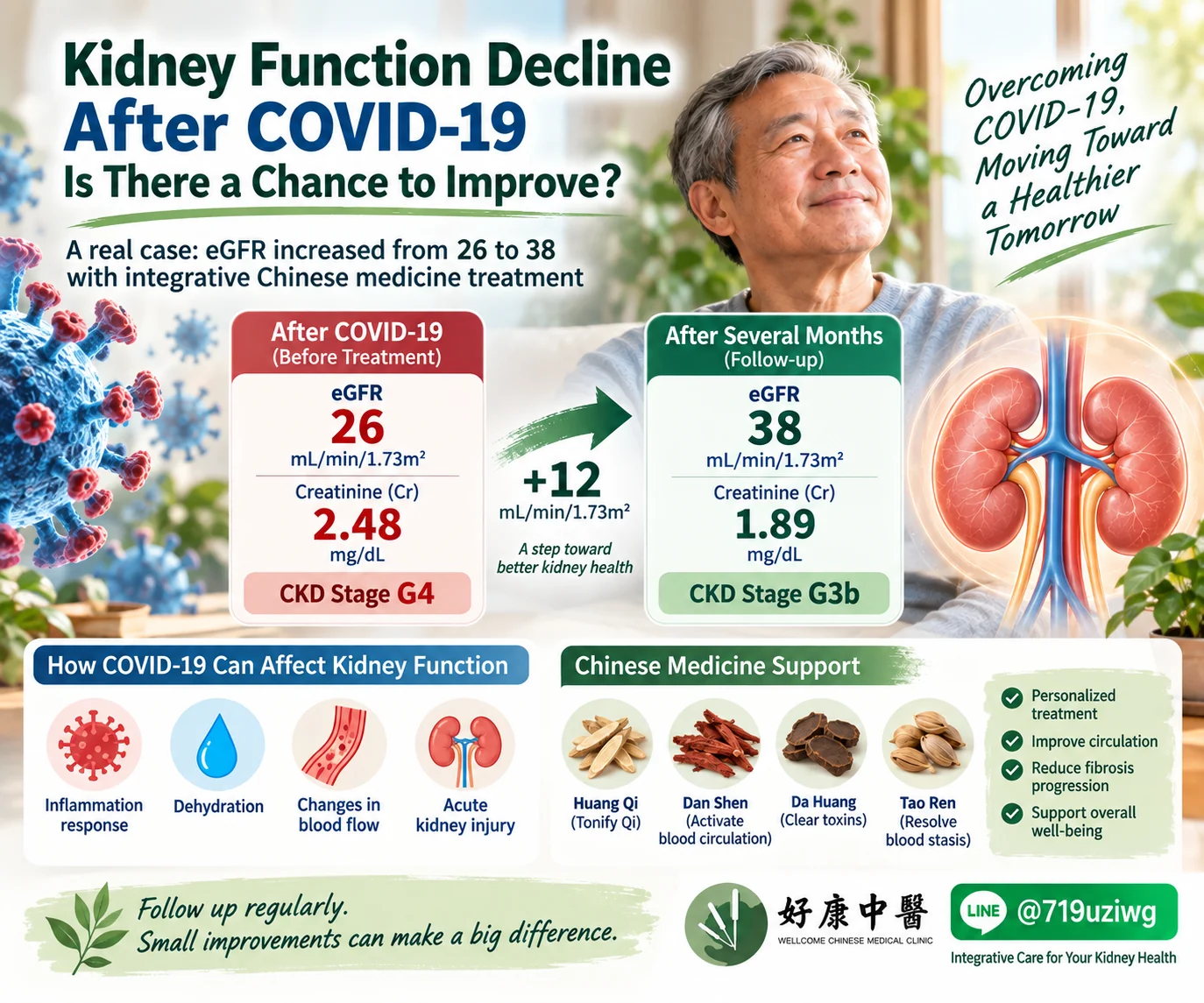
Mr. Wang, a man in his 60s with chronic kidney disease, experienced further deterioration in kidney function after being diagnosed with and treated for COVID-19. His estimated glomerular filtration rate (eGFR) declined to 26 mL/min/1.73 m², while his serum creatinine increased to 2.48 mg/dL.
After several months of treatment, his kidney function improved. His eGFR increased to 38 mL/min/1.73 m², while his serum creatinine decreased to 1.89 mg/dL.
Chronic kidney disease (CKD) refers to abnormalities in kidney structure or function that persist for more than three months and are difficult to fully reverse.
Factors that may contribute to CKD include long-term poor blood glucose control, hypertension, recurrent urinary tract infections, autoimmune-related diseases, and certain nephrotoxic medications.
Referral to a nephrologist should be considered when health examinations reveal significant proteinuria, such as a urine protein-to-creatinine ratio of 300 mg/g or higher, or 24-hour urine protein greater than 500 mg, hematuria accompanied by proteinuria, serum potassium above 5.5 mEq/L, resistant hypertension that remains difficult to control despite four antihypertensive medications, or recurrent multiple kidney stones.
From the perspective of Traditional Chinese Medicine (TCM), chronic kidney disease may fall within traditional categories such as “edema” (水腫) and “kidney wind” (腎風).
Ancient Chinese physicians proposed the concepts of “prolonged illness enters the collaterals” and “prolonged illness inevitably leads to blood stasis.” These concepts describe how long-standing disease may disrupt the normal circulation of Qi and blood, eventually resulting in blood stasis and obstruction. This traditional concept shares some similarities with the process of renal fibrosis described in modern medicine.
The classical text Jin Gui Yao Lue also describes how pathogenic heat, including infection, may contribute to the formation of blood stasis. When blood stasis obstructs the kidney collaterals, manifestations such as proteinuria or hematuria may occur.
Therefore, treatment may include approaches aimed at resolving blood stasis and unblocking the collaterals. As the disease progresses, patients may also develop signs of Qi deficiency, such as fatigue, reduced physical stamina, and increased susceptibility to infection.
Blood-Activating and Stasis-Resolving Herbs for Metabolic Imbalance
TCM treatment often combines Qi-tonifying and blood-activating approaches to support physical function and circulation. Common combinations mentioned in the article include Huang Qi (Astragalus) and Dan Shen (Salvia miltiorrhiza).
Chronic kidney disease may also be described in TCM as involving an interaction between turbid toxins and blood stasis. Clinically, treatment may therefore include approaches to resolve turbidity, clear pathogenic accumulation, activate blood circulation, and dispel blood stasis.
Herbs mentioned in the article include Da Huang (Rhubarb) and Tao Ren (Peach Kernel). For patients with uremic nausea or vomiting, Huang Lian (Coptis) and Zi Su (Perilla) may also be considered according to the individual condition.
Patients with chronic kidney disease should pay attention to potassium and phosphorus intake. A low-potassium diet may be appropriate for some patients depending on laboratory results and kidney function.
Staple foods may prioritize whole grains and minimally processed foods, while reducing high-potassium processed foods, sweets, chocolate products, and high-potassium fruits. Chinese herbal powders and medicinal herbs should also be selected carefully according to potassium content and the patient’s kidney function.
Fruits such as apples, oranges, and pears may be consumed in appropriate portions depending on the individual’s potassium level, nutritional status, and medical advice.
(The author is the Director of Wellcome Chinese Medical Clinic and an Adjunct Attending Physician in the Department of Chinese Medicine at MacKay Memorial Hospital.)
Q1: Why Might Kidney Function Decline After COVID-19?
During an infection, kidney function may fluctuate because of inflammation, dehydration, changes in blood pressure and circulation, or even acute kidney injury.
For patients who already have chronic kidney disease, a significant increase in serum creatinine or decline in eGFR after an infection deserves continued follow-up rather than relying on a single blood test.
Q2: How Much Did This Patient’s Kidney Function Improve?
After COVID-19, Mr. Wang’s kidney function was:
- eGFR: 26 mL/min/1.73 m²
- Creatinine: 2.48 mg/dL
After several months of follow-up:
- eGFR: 38 mL/min/1.73 m²
- Creatinine: 1.89 mg/dL
Kidney Function Before and After Follow-Up
| Indicator | After COVID-19 / Before Follow-Up Treatment | Several Months Later |
|---|---|---|
| eGFR | 26 | 38 |
| Creatinine (Cr) | 2.48 | 1.89 |
| eGFR Category | G4 | G3b |
Net increase in eGFR: +12 mL/min/1.73 m²
Q3: Can This Be Described as an Improvement from Stage 4 to Stage 3?
During follow-up, the patient’s eGFR increased from 26 to 38, moving from the G4 range into the G3b range.
However, this does not mean that chronic kidney disease has been completely cured.
Long-term assessment still requires monitoring of eGFR, serum creatinine, proteinuria or albuminuria, and other markers of ongoing kidney damage.
Q4: Can Chronic Kidney Disease Be Treated with Integrative Chinese Medicine?
The original report describes individualized TCM treatment based on the patient’s constitution and symptoms, using treatment principles such as tonifying Qi, activating blood circulation, resolving blood stasis, and unblocking the collaterals.
The article mentions herbs such as:
- Huang Qi (Astragalus)
- Dan Shen (Salvia miltiorrhiza)
- Da Huang (Rhubarb)
- Tao Ren (Peach Kernel)
However, patients whose kidney function has declined to the G4 or G3b range should not self-prescribe Chinese herbs, herbal remedies, or supplements.
Chinese herbal medicine should be selected according to kidney function, serum potassium and other electrolytes, concurrent Western medications, and the patient’s overall clinical condition. Regular nephrology follow-up should also be continued.
Q5: What Is Most Important When Kidney Function Declines After an Infection?
If eGFR decreases after COVID-19 or another infection, there is no need to panic over a single laboratory value, but the change should not be ignored.
What matters most is comparing laboratory results over time and observing the trend in eGFR and serum creatinine, while also assessing:
- Proteinuria or albuminuria
- Blood pressure
- Blood glucose
- Electrolytes
- Fluid status
- Overall clinical condition
In this case, the follow-up results were:
eGFR: 26 → 38
Creatinine: 2.48 → 1.89 mg/dL
eGFR Category: G4 → G3b
This is an individual patient’s follow-up outcome and should not be interpreted to mean that every patient with chronic kidney disease will experience the same degree of improvement with the same treatment.