
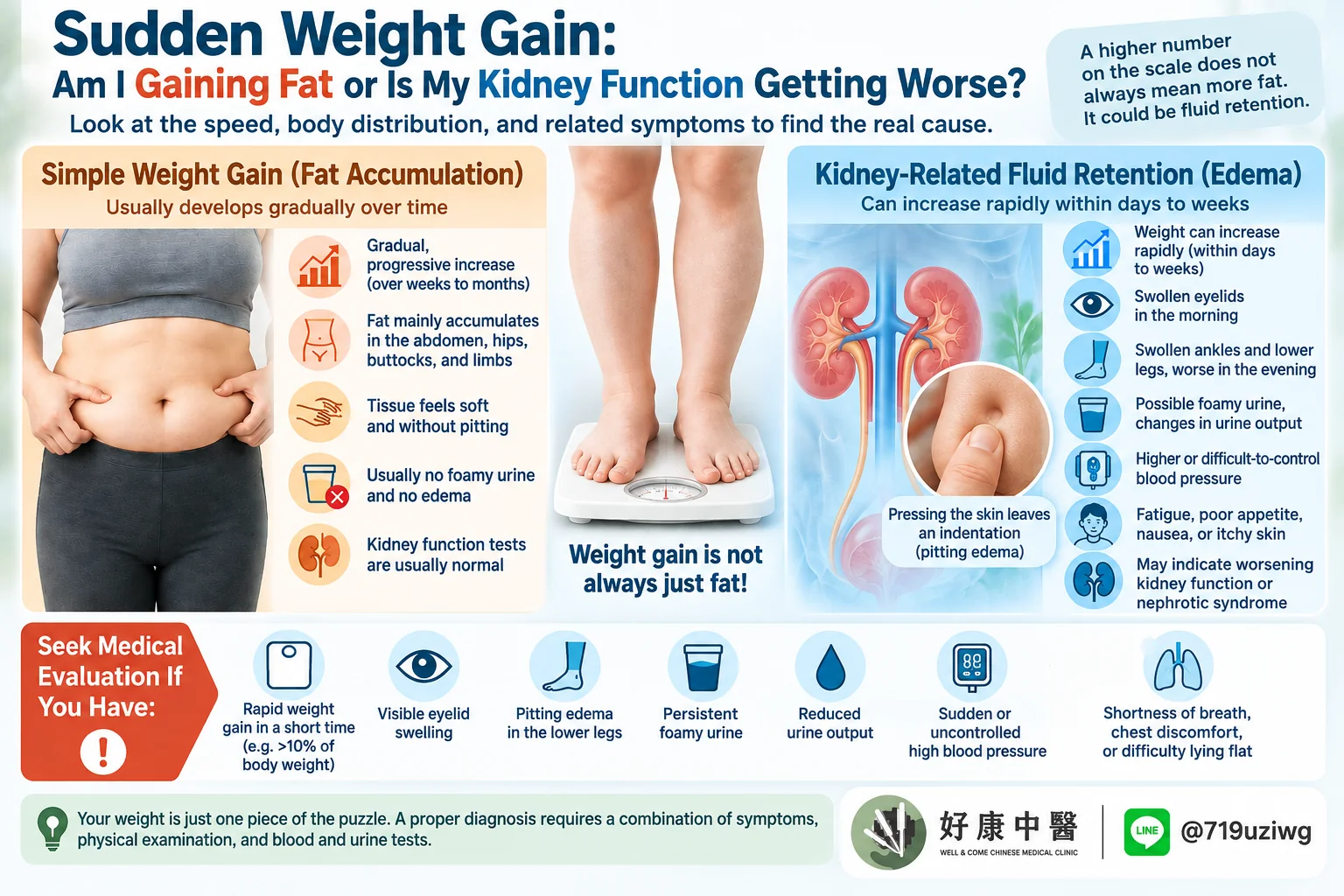
“Doctor, I’ve been gaining weight recently. Am I simply gaining fat, or are my kidneys getting worse and holding onto too much water?”
Weight gain does not always mean an increase in body fat. Clinically, one of the most important questions is whether the extra weight comes from “fat” or from retained “fluid.”
Simple obesity usually develops gradually over weeks to months as body fat accumulates. In contrast, fluid retention related to kidney disease may cause noticeable weight gain within days to weeks, often together with swollen eyelids, leg edema, foamy urine, changes in urine output, or rising blood pressure [1][2].
A scale can only tell you that your body weight has increased. It cannot tell you whether that additional weight comes from fat, muscle, or excess fluid.
How Can You Tell Whether Weight Gain Is From Fat or Fluid Retention?
The first clue is how quickly the weight increases.
With ordinary weight gain, body weight usually rises gradually over a longer period. Fat tends to accumulate around the abdomen, hips, buttocks, and limbs. The tissue generally feels soft and does not leave a visible indentation when pressed.
Fluid retention, however, can cause body weight to rise relatively quickly.
Kidney-related edema often affects the eyelids, ankles, and lower legs. Some people notice puffiness around the eyes in the morning, while by evening their socks leave deeper marks or their shoes feel tighter.
Another important sign is pitting edema.
If you press your thumb firmly over the shin or ankle for several seconds and an indentation remains after you release it, excess fluid may be present in the tissues. Research has shown that patients with renal impairment and edema can have increased extracellular and interstitial fluid volume [3].
Does Weight Gain With Foamy Urine Mean You Should Worry About the Kidneys?
Occasional bubbles in the urine do not necessarily mean kidney disease. A strong urine stream or concentrated urine can also create bubbles.
However, persistent foamy urine together with rapid weight gain, swollen eyelids, or leg edema raises concern for proteinuria.
Kidney disease may also be associated with:
• A significant increase or decrease in urine output
• Increased nighttime urination
• New or worsening high blood pressure
• Fatigue or low energy
• Poor appetite or nausea
• Itching in more advanced kidney dysfunction
These symptoms are not specific to kidney disease, so they cannot establish a diagnosis on their own. Blood and urine tests are still necessary [1][2].
If My eGFR Is Normal, Does That Mean My Kidneys Are Definitely Fine?
Not necessarily.
Kidney health should not be assessed by creatinine or eGFR alone. The KDIGO 2024 Chronic Kidney Disease Guideline recommends assessing both glomerular filtration rate (GFR) and urine albumin in people at risk for kidney disease [4].
This is important because some glomerular diseases can cause significant proteinuria before eGFR declines substantially.
Common initial tests include:
• Serum creatinine
• Estimated glomerular filtration rate (eGFR)
• Routine urinalysis
• Urine protein testing
• Urine albumin-to-creatinine ratio (UACR)
• Serum albumin
• Electrolytes
Therefore, persistent foamy urine and edema should not be ignored simply because a previous blood test showed “normal kidney function.”
My Abdomen Is Getting Bigger. Is It Fat or Ascites?
The speed of waist enlargement can also provide useful information.
Abdominal fat usually accumulates gradually. If the abdomen becomes noticeably larger over a short period, fluid retention or ascites should be considered.
A physician can perform a physical examination and, if necessary, arrange an abdominal ultrasound to determine whether fluid is present in the abdominal cavity.
However, ascites is not specific to kidney disease. Liver cirrhosis, heart failure, low serum albumin, and other medical conditions may also cause abdominal fluid accumulation.
When Should Nephrotic Syndrome Be Suspected?
When a patient develops heavy proteinuria, marked edema, and low serum albumin, doctors may consider nephrotic syndrome and other glomerular diseases.
In this situation, a patient may gain several kilograms within a relatively short period even without eating more food. A substantial portion of that added weight may be fluid rather than fat.
If generalized edema, significantly reduced urine output, shortness of breath, or rapidly worsening kidney function occurs, patients should not self-treat with diuretics or “water-draining” herbal remedies. Proper medical assessment should come first.
For a more detailed discussion of nephrotic syndrome and why it causes heavy protein loss in the urine, please see our next article.
Clinical Example: Weight Gain Is Not Always Caused by Eating Too Much
In clinic, patients often notice weight gain and immediately think, “Maybe I have been eating too much.”
But after more careful questioning, some patients report that their eyelids look puffy in the morning, their ankles swell later in the day, their shoes feel tighter, and pressing the lower leg leaves an indentation. Some also notice that their urine has become increasingly foamy.
At that point, the problem should not be treated as simple obesity alone.
On the other hand, if body weight has increased gradually over several months, waist circumference has also increased, and there is no eyelid swelling, pitting edema, foamy urine, or change in urine output, then diet, physical activity, metabolic health, and obesity become more likely explanations.
If the Problem Is Obesity, How Can Traditional Chinese Medicine Help?
Traditional Chinese Medicine (TCM) weight management is not simply about “removing water” to make the number on the scale go down.
The first step is still to distinguish true fat accumulation from pathological fluid retention.
If obesity and visceral fat accumulation are the main issues, treatment should still focus on diet, physical activity, sleep, and management of metabolic diseases. Chinese herbal medicine may be considered as part of an individualized treatment plan.
One randomized, double-blind, placebo-controlled study evaluated Bofu-tsusho-san, known in Chinese medicine as Fang Feng Tong Sheng San, in obese Japanese women.
The study included 81 women with obesity, impaired glucose tolerance, and insulin resistance, with an average BMI of approximately 36.5. Both groups followed a roughly 1,200 kcal/day diet and exercise program. Participants were then assigned to either Bofu-tsusho-san or placebo for 24 weeks.
The Bofu-tsusho-san group showed greater reductions in body weight and abdominal visceral fat, while adjusted resting metabolic rate did not decline. Fasting insulin, insulin area under the curve, and HOMA-IR also decreased compared with baseline [5].
However, this was a small study involving only 81 Japanese women with a specific metabolic profile. The findings therefore cannot be generalized to everyone seeking weight loss.
In addition, some insulin-related outcomes were mainly before-and-after comparisons within the treatment group, so they should not all be interpreted as proof that the herbal treatment was superior to placebo.
Bofu-tsusho-san also contains herbs such as Ephedra, so it is not appropriate for everyone to purchase and use on their own. Blood pressure, cardiovascular status, current medications, and individual constitution should all be considered before use.
If Kidney Function Is Worsening, How Does TCM Approach It?
“Worsening kidney function” can have many different causes, and treatment should not simply involve tonifying the Kidney or promoting urination whenever creatinine rises.
Dehydration, infection, medications, urinary obstruction, glomerular disease, and sepsis can all cause acute kidney injury (AKI), and the management differs considerably depending on the cause.
A recent systematic review and meta-analysis evaluated Xuebijing injection as an adjunctive treatment for sepsis-associated acute kidney injury.
The analysis included 18 randomized controlled trials involving 1,650 participants. Compared with conventional treatment alone, adding Xuebijing showed possible signals of benefit for 28-day mortality and some kidney-function outcomes.
However, the certainty of evidence ranged from moderate to very low, and the original trials had important methodological limitations. Therefore, Xuebijing should not be regarded as an established standard treatment for AKI.
It is also important not to assume that oral use of herbs with similar ingredients would produce the same effects as an injectable preparation studied in clinical trials.
How Does Dr. Gao Approach Integrated Chinese and Western Medicine for Acute Kidney Injury?
In previous cases of integrated Chinese and Western medical care for acute kidney injury, Dr. Gao Hao-Yu first evaluates the underlying cause of the kidney injury, together with the patient’s circulation, infection status, and overall fluid balance.
From a TCM perspective, some patients may be treated with mild fluid-regulating strategies together with Qi-supporting and blood-activating therapies to improve circulation. Kidney-tonifying approaches may be considered later depending on recovery and the patient’s overall pattern.
However, the acute phase is not simply a situation where “the kidneys are weak, so they must be tonified immediately.”
In patients with infection, sepsis, or ongoing acute inflammation, overly rich or strongly tonifying formulas used without proper pattern differentiation may be inappropriate.
More importantly, sepsis-associated AKI can be life-threatening. TCM should only be used as an adjunct to appropriate modern medical care, including infection control, hemodynamic support, and renal replacement therapy when necessary. It should never replace acute medical treatment.
When Does Weight Gain Require Prompt Medical Evaluation?
Weight gain should not simply be observed if any of the following are present:
• Rapid weight gain over several days
• Significant eyelid, ankle, or lower-leg swelling
• Pitting edema
• Persistent foamy urine
• A sudden reduction in urine output
• Newly elevated or difficult-to-control blood pressure
• Shortness of breath, chest discomfort, or difficulty lying flat
If edema, reduced urine output, and shortness of breath occur together, prompt medical evaluation is particularly important.
When trying to determine whether weight gain is caused by “fat” or “fluid,” the number on the scale is only one piece of information.
The speed of weight gain, body distribution, urine changes, blood pressure, and blood and urine test results all need to be considered together.
Identifying the cause first, and only then deciding whether the appropriate treatment is weight management, fluid management, or kidney-related care, is the safer approach.
FAQ
1. If I Gain One Kilogram in One Day, Does That Mean I Gained Fat?
Not necessarily. Short-term weight changes are strongly affected by fluid balance, sodium intake, bowel movements, and the timing of measurement. If weight rises rapidly for several consecutive days and is accompanied by swelling, fluid retention should be considered.
2. Does Leg Swelling Always Mean Kidney Disease?
No. Heart disease, liver disease, venous insufficiency, low serum albumin, and certain medications can also cause leg edema. The underlying cause should be identified before treatment.
3. Does Foamy Urine Always Mean Proteinuria?
No. However, if foamy urine is persistent, especially in someone with edema, hypertension, diabetes, or other kidney-disease risk factors, urine protein and UACR testing should be considered.
4. Can I Still Have Kidney Disease if My eGFR Is Normal?
Yes. Some glomerular diseases may initially present with albuminuria or proteinuria before eGFR falls significantly. For this reason, KDIGO recommends assessing both GFR and urine albumin in people at risk for chronic kidney disease [4].
5. Can I Buy Bofu-tsusho-san and Use It for Weight Loss on My Own?
Self-treatment is not recommended. Although clinical research suggests that it may reduce body weight and visceral fat in certain obese populations, the available evidence comes from relatively small and specific patient groups. The formula may also contain Ephedra and may not be appropriate for people with certain cardiovascular conditions, hypertension, or medication interactions. It should be used only after evaluation by a qualified TCM physician.