
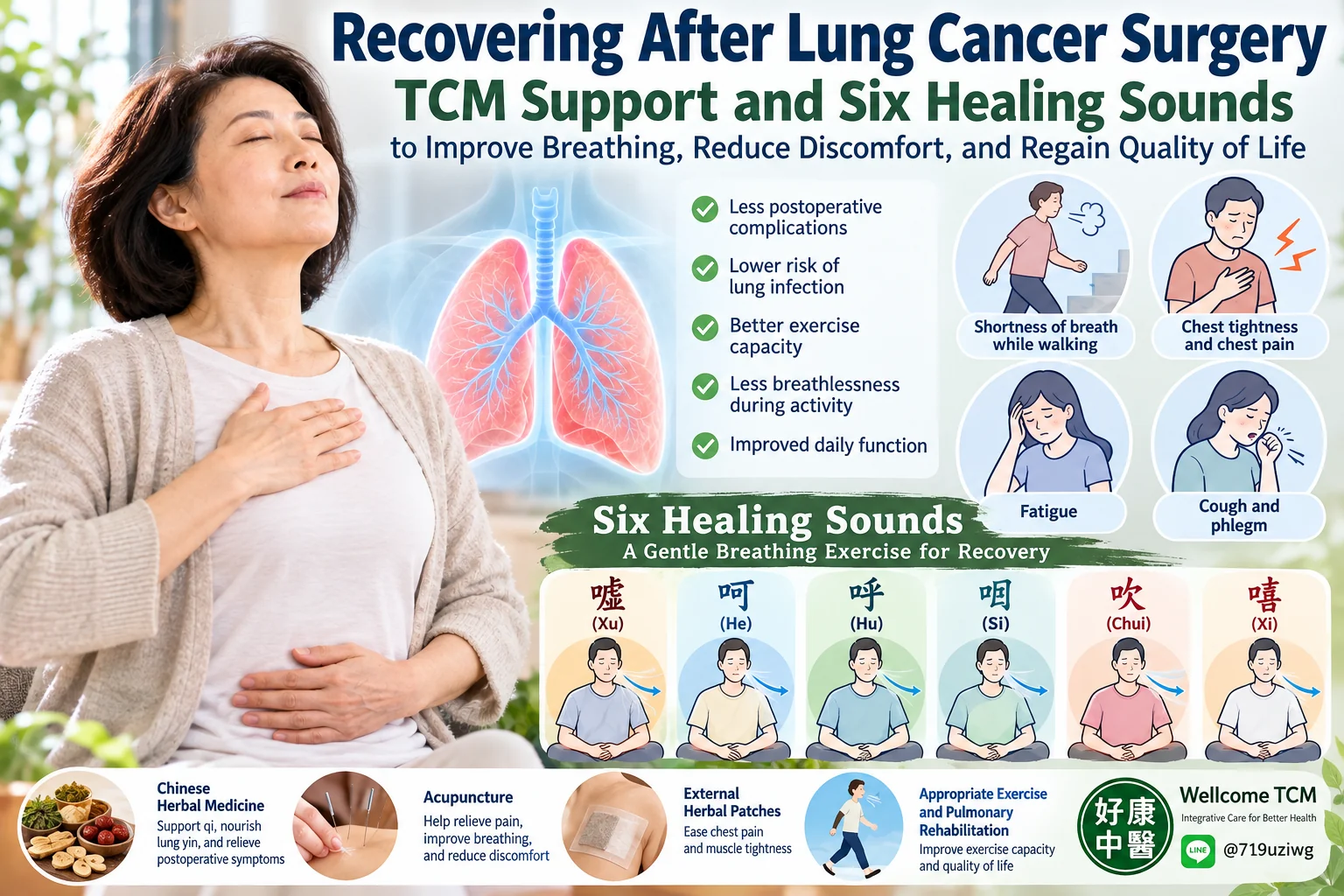
After lung cancer surgery, chemotherapy, or radiation therapy, many patients need time to regain their strength even after the main phase of cancer treatment has been completed.
Common problems include shortness of breath while walking, coughing, chest discomfort or pain, fatigue, and reduced exercise capacity. Some patients may become breathless after walking only a short distance.
These symptoms do not necessarily mean that the cancer has progressed or returned. They may be related to changes in lung function after surgery, postoperative pain, reduced physical activity, or the effects of chemotherapy and radiation therapy.
For this reason, regular follow-up with thoracic surgeons, pulmonologists, and oncologists remains essential. Depending on the patient’s condition, pulmonary rehabilitation and appropriate exercise may also be recommended.
Some patients also seek Traditional Chinese Medicine (TCM) as part of supportive care to help manage symptoms such as shortness of breath, cough, fatigue, poor appetite, and discomfort during recovery.
Can TCM Help With Shortness of Breath and Fatigue After Lung Cancer Treatment?
Ms. Chen, a woman in her 50s, unexpectedly discovered a lung tumor during a routine health examination.
She subsequently underwent surgery, chemotherapy, and radiation therapy. Although the major cancer treatments had been completed, she continued to experience several uncomfortable symptoms.
She became easily short of breath while walking, felt significantly more tired than before, and frequently experienced chest tightness and chest pain. She therefore sought additional support from Traditional Chinese Medicine.
After an individualized TCM assessment, her treatment included concentrated Chinese herbal medicine based on the principles of supporting qi and nourishing lung yin, together with herbal decoctions, acupuncture, and external herbal patches.
After a period of treatment, Ms. Chen reported considerable improvement in her chest discomfort and shortness of breath while walking, making daily activities easier.
However, every patient with lung cancer is different. Cancer stage, surgical procedure, chemotherapy or radiation therapy, medications, age, lung function, and general health can all affect recovery.
This case should therefore be viewed as an individual clinical experience rather than evidence that the same treatment will produce the same results in every patient.
Why Are Cough, Shortness of Breath, Chest Pain, and Fatigue Common After Lung Cancer Surgery?
Lung cancer surgery may involve removing a wedge of lung tissue, a lung segment, or an entire lobe. As a result, respiratory function and exercise capacity can temporarily change after surgery.
During the first week after lung cancer surgery, coughing, shortness of breath during physical activity, chest pain, and fatigue are common postoperative complaints. These symptoms may be more noticeable during the early recovery period and gradually improve as the body heals [1].
Pain can also interfere with breathing.
Some patients avoid taking deep breaths or coughing because they are afraid of pulling on the surgical wound. This may result in shallow breathing and make it more difficult to clear mucus.
Appropriate pain management, breathing exercises, gradual physical activity, and pulmonary rehabilitation are therefore important parts of postoperative recovery.
However, worsening breathlessness should not automatically be considered a normal postoperative symptom.
If shortness of breath suddenly becomes worse or is accompanied by fever, coughing up blood, increasing chest pain, or a drop in blood oxygen saturation, medical evaluation is necessary to rule out conditions such as pneumonia, pulmonary embolism, pneumothorax, pleural effusion, or other postoperative complications.
Is There Evidence for Chinese Herbal Medicine and Six Healing Sounds After Lung Cancer Surgery?
A randomized controlled clinical study investigated patients undergoing video-assisted thoracoscopic surgery for lung cancer. A total of 90 patients were included in the final analysis, with 45 receiving conventional postoperative treatment and another 45 receiving conventional treatment combined with individualized Chinese herbal medicine and Six Healing Sounds exercises [1].
The herbal treatment was not identical for every patient.
For patients whose main symptoms included cough, excessive phlegm, or difficulty breathing, modified Ban Xia Hou Po Tang and Sang Ju Yin were used.
For patients experiencing gastrointestinal symptoms such as abdominal bloating, poor appetite, or constipation, modified Bao He Wan and Ping Wei San were used.
Patients in the intervention group also practiced Six Healing Sounds breathing exercises under professional guidance.
The results showed fewer overall postoperative complications and fewer pulmonary infections in the intervention group.
Exercise capacity also showed improvement. After treatment, the intervention group achieved approximately 51 meters greater improvement in the six-minute walking distance compared with the control group. They also experienced less perceived breathlessness before and after exercise [1].
The study additionally suggested that pain had less impact on certain aspects of daily activity in the intervention group.
Can Chinese Herbal Medicine Reduce Postoperative Cough and Pain?
Although the study reported several encouraging findings, its limitations are important.
Some cough-related outcomes did not show consistent statistically significant differences between the two groups. The intensity of pain itself also was not clearly shown to improve simply because of the intervention [1].
More importantly, Chinese herbal medicine and Six Healing Sounds exercises were used together.
Therefore, even though improvements in exercise capacity and certain postoperative outcomes were observed, the study cannot determine how much of the effect came from the herbal treatment and how much came from breathing rehabilitation.
Based on current evidence, TCM is better considered part of supportive and integrative postoperative care rather than a replacement for thoracic surgery follow-up, pain management, pulmonary rehabilitation, infection assessment, or standard cancer treatment.
What Are the Six Healing Sounds?
The Six Healing Sounds, known as Liu Zi Jue in Chinese, are a traditional breathing exercise combining slow breathing, prolonged exhalation, and six specific vocal sounds.
The six sounds are traditionally pronounced in sequence as:
“Xu, He, Hu, Si, Chui, Xi.”
Recent systematic reviews and meta-analyses suggest that traditional Chinese exercises, including Six Healing Sounds practices, may benefit exercise capacity, respiratory function, or quality of life in some patients recovering from lung cancer surgery [2][3].
However, exercise protocols, treatment duration, and study quality vary considerably. More high-quality clinical research is still needed.
For postoperative lung cancer patients, the primary goal is not to perform the sounds perfectly. The more important objective is to develop controlled, relaxed breathing and gradually restore physical activity.
How Do You Practice the Six Healing Sounds?
Begin in a comfortable seated position. Keep your back naturally upright while relaxing your shoulders and neck.
Inhale gently through your nose for approximately two to three seconds.
Then slowly exhale through your mouth for approximately four to six seconds. The exhalation should be slightly longer than the inhalation.
There is no need to take an extremely deep breath, forcefully empty the lungs, or hold your breath.
The six sounds are then performed slowly in sequence:
“Xu, He, Hu, Si, Chui, Xi.”
Each sound can initially be practiced three to six times, depending on the patient’s physical condition.
Take breaks whenever necessary and return to normal breathing between repetitions. A complete session may take approximately 10 to 15 minutes.
For patients recovering from lung cancer surgery, the objective is to maintain comfortable and stable breathing rather than producing loud sounds or holding the breath for a long time.
If coughing causes discomfort around the surgical wound, a pillow may be gently held against the operated side of the chest for support while coughing.
Stop the exercise immediately if dizziness, palpitations, worsening chest pain, significant shortness of breath, or a noticeable decrease in oxygen saturation occurs.
Does Pulmonary Rehabilitation Help After Lung Cancer Surgery?
Evidence supporting pulmonary rehabilitation and appropriate exercise after lung cancer surgery has been growing.
Systematic reviews and meta-analyses suggest that postoperative exercise and pulmonary rehabilitation may improve six-minute walking distance, exercise capacity, and certain respiratory symptoms in patients with lung cancer [3][4].
For this reason, patients should not necessarily avoid all physical activity simply because they become mildly breathless when moving.
Prolonged inactivity can contribute to further loss of muscle strength, physical conditioning, and cardiopulmonary endurance.
A more appropriate approach is to gradually resume walking, breathing exercises, and suitable physical activity according to the patient’s surgical procedure, cardiopulmonary function, age, and overall medical condition.
Can I Take Chinese Herbal Medicine During Chemotherapy, Radiation, Targeted Therapy, or Immunotherapy?
Some patients require chemotherapy, radiation therapy, targeted therapy, or immunotherapy even after lung cancer surgery.
In these situations, the key principle is integrative care rather than replacing conventional cancer treatment with Chinese herbal medicine.
The Taiwan Lung Cancer Society also advises that patients interested in using TCM during cancer treatment should be evaluated by qualified TCM physicians according to their constitution, current medical condition, and ongoing conventional treatments. Standard cancer treatment should remain the primary therapy, with TCM used as supportive care when appropriate [5].
In clinical practice, integrative TCM care may focus on symptoms such as fatigue, poor appetite, sleep problems, dry mouth, cough, pain, or gastrointestinal discomfort, with the goal of supporting quality of life and helping patients cope with treatment.
However, improving treatment-related symptoms and preventing cancer recurrence are two different claims.
Current evidence does not justify assuming that symptom improvement means that Chinese herbal medicine can prevent lung cancer recurrence.
Patients receiving chemotherapy, targeted therapy, or immunotherapy may also be taking multiple medications. Herbal medicines, supplements, and other products can potentially interact with conventional treatments.
Patients should therefore avoid taking unprescribed herbal remedies or supplements without discussing them with their healthcare professionals.
What Else Can Patients Do After Lung Cancer Surgery?
Regular medical follow-up and completion of the recommended cancer treatment remain the foundation of long-term care after lung cancer surgery.
Patients who smoke should stop smoking as early as possible.
A balanced diet should provide adequate calories, protein, vegetables, and fruit. Excessive dietary restrictions should be avoided, particularly if they lead to continued weight loss or loss of muscle mass.
When medically appropriate, patients should gradually resume walking and regular physical activity.
If shortness of breath during activity remains severe, discuss pulmonary rehabilitation with a pulmonologist or rehabilitation professional.
From a TCM self-care perspective, patients who frequently experience cough or breathlessness may also discuss gentle acupressure at points such as Kongzui (LU6) and Taiyuan (LU9) with a qualified healthcare professional.
Acupressure should be considered supportive self-care and should never replace lung cancer treatment or medical follow-up.
Recovery After Lung Cancer Treatment Is About More Than Treating the Tumor
For many people with lung cancer, finishing surgery or chemotherapy does not mean that every symptom will immediately disappear.
Shortness of breath, cough, chest discomfort, fatigue, and reduced physical capacity can make patients afraid to exercise. Some may also worry that these symptoms mean the cancer has returned.
The first step is to identify the cause of the symptoms. Appropriate pain management, pulmonary rehabilitation, exercise, nutrition, and other supportive treatments can then be arranged according to individual needs.
Chinese herbal medicine, acupuncture, and Six Healing Sounds exercises may be considered as part of integrative supportive care after appropriate medical assessment.
Existing research has produced some encouraging findings, but these approaches should not replace standard cancer treatment. Improvement in symptoms should also not be interpreted as proof of anticancer effects or prevention of cancer recurrence.
For patients recovering from lung cancer treatment, the goal is to safely and gradually rebuild breathing capacity, physical strength, daily function, and quality of life.
FAQ: Common Questions After Lung Cancer Surgery
Is Shortness of Breath Normal After Lung Cancer Surgery?
Some degree of shortness of breath during activity can occur after lung surgery, particularly during the early recovery period. However, sudden or severe worsening of breathlessness, especially with fever, chest pain, coughing up blood, or low oxygen saturation, requires prompt medical evaluation.
Why Am I Still Coughing After Lung Cancer Surgery?
Postoperative coughing may be associated with airway irritation, anatomical changes after surgery, mucus, or other pulmonary conditions. Persistent or worsening cough should be evaluated by a medical professional to determine the cause.
When Can I Exercise After Lung Cancer Surgery?
There is no single timeline suitable for every patient. Once the medical team confirms that the patient’s condition is stable, recovery often begins with getting out of bed, short walks, and gentle breathing exercises, followed by gradual increases in physical activity.
Can I Practice Six Healing Sounds Every Day?
Patients whose postoperative condition is stable may begin with short, gentle sessions if their healthcare professionals consider the exercise appropriate. Breathing should remain comfortable and relaxed. Stop if dizziness, chest pain, significant breathlessness, or other concerning symptoms develop.
Can I Take Chinese Herbal Medicine During Lung Cancer Chemotherapy?
Chinese herbal medicine may be considered in selected patients, but the TCM physician should know all current chemotherapy drugs, targeted therapies, immunotherapies, and other medications. Herbal medicine should be used as part of coordinated supportive care and should not replace standard cancer treatment.
References
[1] Gu Y, Wang Y, Zhou H, et al. Efficacy of Chinese Medicine on Postoperative Rehabilitation of Non-small Cell Lung Cancer (NSCLC), a Randomized Controlled Study. Integrative Cancer Therapies. 2025;24.
https://pmc.ncbi.nlm.nih.gov/articles/PMC11803757/
[2] He P, Chen H, Gong L, et al. Meta-analysis of the effect of Six-character formula on pulmonary function rehabilitation. Beijing Journal of Traditional Chinese Medicine. 2021;40(12):1405-1409.
https://www.bjtcm.net/en/article/doi/10.16025/j.1674-1307.2021.12.028/
[3] Song et al. Efficacy of traditional Chinese exercise on postoperative rehabilitation in lung cancer patients: a systematic review and meta-analysis. Journal of Thoracic Disease. 2026.
https://pubmed.ncbi.nlm.nih.gov/42306719/
[4] Effect of Exercise and Pulmonary Rehabilitation in Pre- and Post-Surgical Patients with Lung Cancer: Systematic Review and Meta-Analysis. 2024.
https://pmc.ncbi.nlm.nih.gov/articles/PMC11595816/
[5] Taiwan Lung Cancer Society. Patient Education: Traditional Chinese Medicine and Lung Cancer Care.
https://www.tlcs.org.tw/ehc-tlcs/s/w/qaList/qa
Article Source
This educational article is adapted in part from the Liberty Times / Liberty Health Network (自由時報/自由健康網) article:
“Shortness of Breath, Chest Tightness and Fatigue After Lung Cancer Chemotherapy: TCM Intervention Helps Improve Symptoms”
Published: October 5, 2026, 05:30
By Kao Hao-Yu (高晧宇)
Original article:
https://health.ltn.com.tw/article/paper/1773314
This article is provided for general health education. Treatment decisions should be individualized according to cancer stage, surgical procedure, current medications, ongoing cancer treatment, lung function, and the patient’s overall medical condition.