
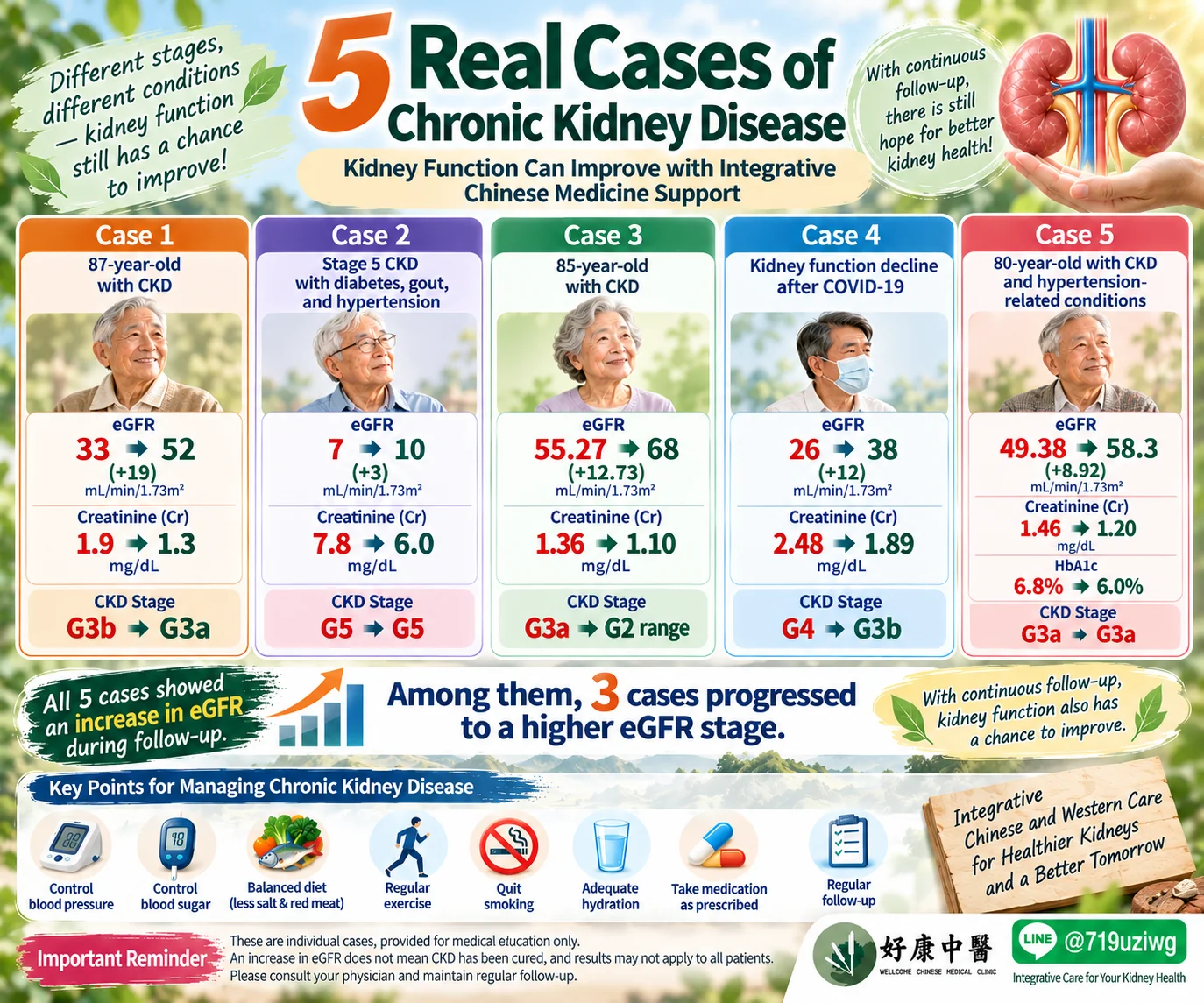
Integrative Chinese Medicine Support for Improving eGFR | Case Summary
Case Sources: Liberty Times / Liberty Times Health
By Kao Hao-Yu
“Once chronic kidney disease is diagnosed, does kidney function only continue to decline?”
“If my eGFR has already dropped, can it rise again?”
“Can Stage 3 kidney disease move into the Stage 2 range?”
“If I already have Stage 5 CKD, can my kidney function still improve?”
These are common questions raised by patients with chronic kidney disease.
Over the past several years, we have shared five CKD follow-up cases involving patients with different ages, underlying conditions, baseline kidney function, and CKD categories, ranging from G3a and G3b to G4 and G5.
This article brings all five cases together to compare changes in estimated glomerular filtration rate (eGFR), serum creatinine (Cr), and CKD category before and after follow-up.
It is important to emphasize that these are individual clinical cases. An increase in eGFR does not mean that chronic kidney disease has been cured, and individual case outcomes cannot be generalized to all patients receiving similar treatment.
How Much Did Kidney Function Improve in These 5 CKD Cases?
| Case | Patient Profile | eGFR Change | eGFR Increase | Cr Change | eGFR Category Change |
|---|---|---|---|---|---|
| Case 1 | 87-year-old with CKD | 33 → 52 | +19 | 1.9 → 1.3 | G3b → G3a |
| Case 2 | Stage 5 CKD with diabetes, gout, and hypertension | 7 → 10 | +3 | 7.8 → 6.0 | G5 → G5 |
| Case 3 | 85-year-old with CKD | 55.27 → 68 | +12.73 | 1.36 → 1.10 | G3a → G2 range |
| Case 4 | Kidney function decline after COVID-19 | 26 → 38 | +12 | 2.48 → 1.89 | G4 → G3b |
| Case 5 | 80-year-old with CKD and hypertension-related comorbidities | 49.38 → 58.3 | +8.92 | 1.46 → 1.20 | G3a → G3a |
Across all five cases, follow-up showed an increase in eGFR together with a decrease in serum creatinine.
However, each patient had a different baseline level of kidney function, different comorbidities, different clinical circumstances, and different follow-up periods. Therefore, these numbers are useful for understanding each patient’s individual trend, but they should not be used to rank which patient had the “best treatment response.”
Q1: Which Cases Actually Changed CKD eGFR Category?
Among the five cases, three crossed an eGFR category threshold during follow-up.
Case 1: G3b → G3a
The 87-year-old patient initially had:
eGFR 33, Cr 1.9 mg/dL
After about 3 months:
eGFR 44, Cr 1.5 mg/dL
After another approximately 3 months:
eGFR 52, Cr 1.3 mg/dL
Overall, eGFR increased from 33 to 52, a net increase of 19.
It is important to note that an eGFR of 44 is still within the G3b range. The patient entered the G3a range only after eGFR reached 52.
Case 3: G3a → G2 Range
During follow-up, the 85-year-old patient showed:
eGFR: 55.27 → 68
Cr: 1.36 → 1.10 mg/dL
The net increase in eGFR was 12.73, moving from the G3a range into the G2 range.
However, entering the G2 range does not mean that CKD can be declared cured based on a single test. Proteinuria, urinalysis, imaging findings, and long-term kidney function trends still need to be considered.
Case 4: G4 → G3b
This patient in his 60s already had chronic kidney disease. After COVID-19 infection and treatment, kidney function declined to:
eGFR 26, Cr 2.48 mg/dL
After several months of treatment and follow-up:
eGFR 38, Cr 1.89 mg/dL
The net eGFR increase was 12, moving from the G4 range into the G3b range.
Q2: Why Did the Other Two Cases Show Higher eGFR Without a Change in CKD Category?
Because improvement in eGFR and crossing an eGFR category threshold are not the same thing.
Case 2: eGFR 7 → 10, Still G5
During follow-up in this patient with Stage 5 CKD:
eGFR: 7 → 10
Cr: 7.8 → 6.0 mg/dL
Although eGFR increased by 3, both 7 and 10 are below 15, so the patient remained in the G5 range.
A more accurate description is:
“During follow-up for Stage 5 CKD, eGFR increased from 7 to 10, but the patient remained within the G5 range.”
It should not be described as “Stage 5 improving to Stage 4.”
Case 5: eGFR 49.38 → 58.3, Still G3a
The 80-year-old patient had hypertension, hyperlipidemia, cardiac arrhythmia, and chronic kidney disease.
During follow-up:
eGFR: 49.38 → 58.3
Cr: 1.46 → 1.20 mg/dL
HbA1c: 6.8% → 6.0%
The net increase in eGFR was 8.92.
However, both 49.38 and 58.3 fall within the G3a range of 45–59, so the category remained G3a → G3a.
This is why a higher eGFR does not automatically mean that the CKD stage has changed.
Q3: Does the Largest Increase in eGFR Mean the Best Treatment Result?
No.
The increases in eGFR across the five cases were:
Case 1: +19
Case 3: +12.73
Case 4: +12
Case 5: +8.92
Case 2: +3 mL/min/1.73 m²
But the patients differed in age, baseline eGFR, CKD category, chronic diseases, infection status, medications, and follow-up duration.
Therefore, the purpose of this comparison is to help readers understand each patient’s own before-and-after kidney function trend, not to rank treatment effectiveness across different patients.
Q4: Does an Increase in eGFR Mean That Chronic Kidney Disease Has Been Reversed or Cured?
Not necessarily.
eGFR is an estimated measure of kidney filtration based largely on serum creatinine and other patient characteristics, and it can be influenced by overall health status.
Infection, dehydration, blood pressure changes, blood glucose control, medications, and acute kidney injury can all affect serum creatinine and eGFR.
For this reason, the most important clinical information is often the trend over time, rather than a single laboratory result.
In addition to eGFR and creatinine, clinicians may also evaluate:
- Proteinuria or albuminuria
- Blood pressure
- Blood glucose
- Potassium and other electrolytes
- Body weight and edema
- Urine output
- Anemia and nutritional status
- Other markers of kidney damage
Even when eGFR moves from G3a into the G2 range, this does not automatically mean that chronic kidney disease has completely resolved.
Q5: Do These 5 Cases Prove That Chinese Medicine Always Increases eGFR?
No.
These five articles describe kidney function changes observed in individual patients during treatment and follow-up.
Case reports can provide useful clinical observations, but they cannot by themselves prove that Chinese medicine directly caused the increase in eGFR, nor can they guarantee the same response in other patients with CKD.
In actual CKD care, we place greater emphasis on:
Integrative Chinese medicine support + standard medical care + chronic disease management + lifestyle modification + continued laboratory follow-up.
Hypertension, diabetes, hyperlipidemia, hyperuricemia, and other conditions may all affect long-term kidney function, so CKD management should not focus on only one factor.
Q6: Why Is Long-Term Follow-Up So Important in Chronic Kidney Disease?
Because kidney function cannot be judged from one blood test alone.
Some patients become very anxious after a single drop in eGFR, while others assume their kidney disease is cured after one higher result.
Both interpretations may be premature.
It is more useful to compare laboratory results over 3 months, 6 months, or even longer periods.
For example:
Is eGFR continuing to decline, remaining stable, or gradually increasing?
Does the creatinine trend match the eGFR trend?
Is proteinuria increasing or decreasing?
How well are blood pressure, blood glucose, and other chronic conditions being controlled?
Looking at these results together provides a more complete picture of kidney function over time.
Q7: What Should CKD Patients Consider If They Want to Combine Chinese and Western Medical Care?
Traditional Chinese Medicine treatment for CKD should be individualized according to the patient’s overall clinical condition.
In addition to TCM pattern differentiation, clinicians should understand the patient’s current:
eGFR, serum creatinine, proteinuria, potassium level, blood pressure, blood glucose, chronic medical conditions, and current Western medications.
Patients with G3b, G4, or G5 kidney function in particular should not self-prescribe Chinese herbal medicine, herbal remedies, or dietary supplements.
Some herbs or supplements may affect electrolyte balance or kidney function and may also interact with prescription medications.
Chinese medicine should be used as part of an overall treatment plan, while appropriate nephrology follow-up and medically necessary treatment should continue.
What Can We Learn from These 5 CKD Cases?
Looking back at the five cases:
Case 1 | eGFR 33 → 52: G3b → G3a
Case 2 | eGFR 7 → 10: G5 → G5
Case 3 | eGFR 55.27 → 68: G3a → G2 range
Case 4 | eGFR 26 → 38: G4 → G3b
Case 5 | eGFR 49.38 → 58.3: G3a → G3a
The main message of this series is not that “everyone’s kidney function can be reversed.”
Instead:
Chronic kidney disease requires long-term management and continued follow-up.
A single decline in eGFR does not necessarily mean that kidney function will continue to worsen indefinitely, and one higher eGFR result does not mean that chronic kidney disease has been cured.
Recording each laboratory result and following changes in eGFR, serum creatinine, proteinuria, and chronic disease control over time provides a more complete understanding of kidney function.
For patients with CKD, the goal is not simply to achieve one “good-looking number.” The more important goal is to maintain kidney function as safely and steadily as possible, address potentially reversible factors, and reduce the risk of further deterioration through appropriate medical follow-up.
Article Sources
Case 1 | Liberty Times / Liberty Times Health
慢性腎臟病友 中醫診療神助攻
Published: July 27, 2024
Case 2 | Liberty Times / Liberty Times Health
慢性腎臟病惱人 中藥調理延緩惡化
Published: October 13, 2025
Case 3 | Liberty Times / Liberty Times Health
85歲翁怕洗腎 中醫對症解困擾
Published: March 14, 2021
Case 4 | Liberty Times / Liberty Times Health
中醫治腎病 化瘀通絡減緩纖維化
Published: July 10, 2026
Case 5 | Liberty Times / Liberty Times Health
慢性腎臟病搭配中醫 延後透析
Published: February 12, 2023
By Kao Hao-Yu
Director, Wellcome Chinese Medical Clinic
Adjunct Attending Physician, Department of Chinese Medicine, MacKay Memorial Hospital