
Source: Liberty Times / Liberty Times Health
Original Article: 慢性腎臟病惱人 中藥調理延緩惡化
Publication Date: October 13, 2025
Original Article: Liberty Times
By Kao Hao-Yu
Mr. Yang, a man in his 60s with a history of smoking, was diagnosed with chronic kidney disease and had suffered from proteinuria and insomnia for many years. After several months of adjustment with Chinese herbal medicine, his proteinuria was no longer detected, and both his sleep quality and energy level improved significantly.
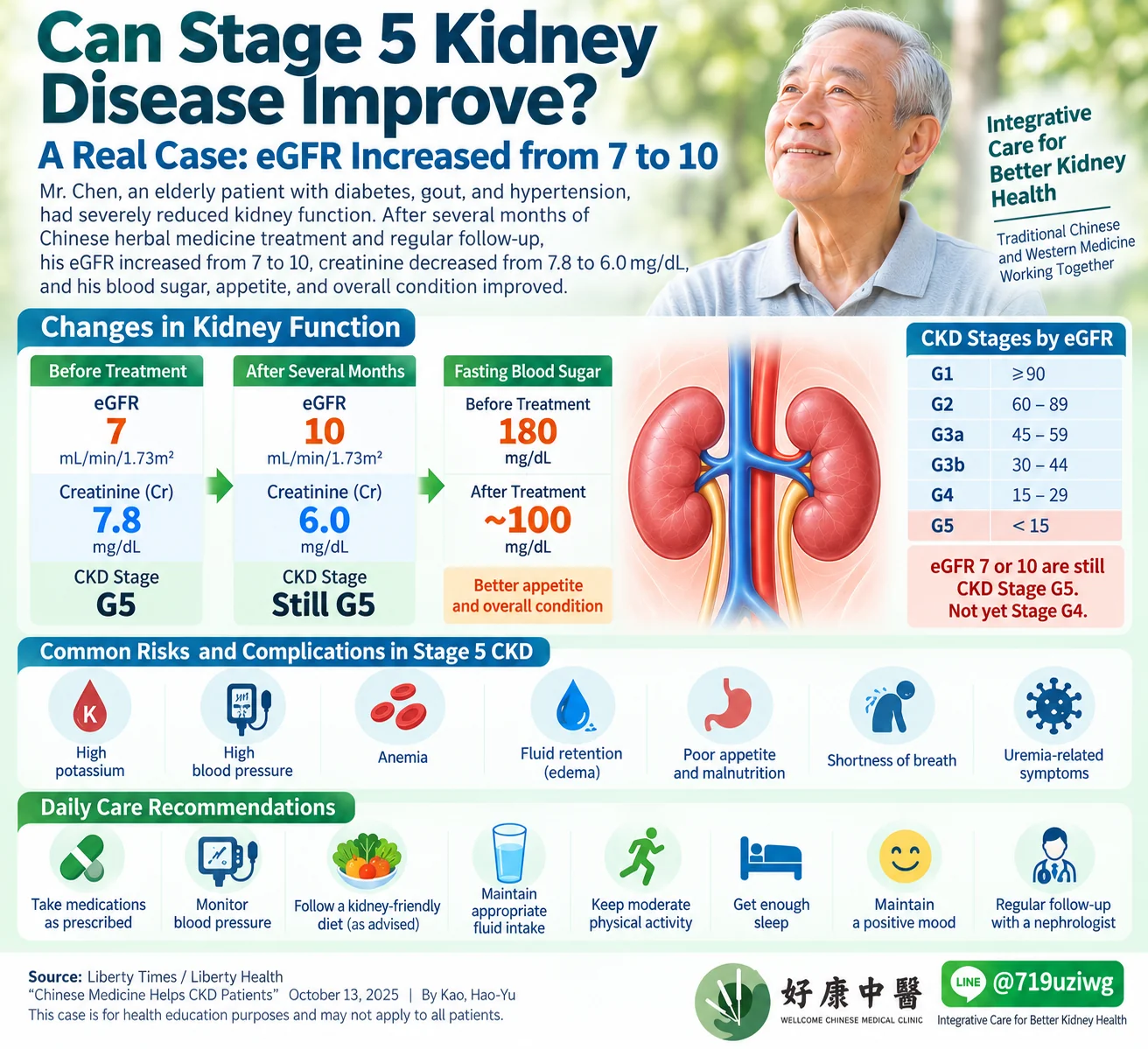
Another patient, Mr. Chen, had long suffered from diabetes, gout, and hypertension. His estimated glomerular filtration rate (eGFR) had declined to 7 mL/min/1.73 m², while his serum creatinine had increased to 7.8 mg/dL, indicating a very high risk of requiring dialysis.
After several months of Chinese herbal medicine treatment, his eGFR increased to 10 mL/min/1.73 m², while his serum creatinine decreased to 6.0 mg/dL. His fasting blood glucose also decreased from 180 mg/dL to approximately 100 mg/dL. In addition, his overall energy and appetite improved, and he no longer needed to take unexpected sick leave.
Chronic kidney disease (CKD) refers to abnormalities of kidney structure or function that persist for more than three months. Common causes and contributing conditions include hypertension, high blood glucose, urinary tract infections, autoimmune diseases, and medications.
Clinically, kidney damage may be identified through proteinuria, abnormalities in urinary sediment, or imaging studies. Patients with severe proteinuria (urine protein-to-creatinine ratio ≥300 mg/g), serum potassium above 5.5 mEq/L, resistant hypertension, or recurrent kidney stones should seek nephrology evaluation as early as possible.
From the perspective of Traditional Chinese Medicine (TCM), chronic kidney disease may fall within traditional categories such as “edema” (水腫), “kidney wind” (腎風), or “oily/turbid urine” (小便如膏). Although the kidney is considered the primary organ involved, the condition may also be closely related to the spleen, stomach, heart, liver, and lungs.
In the early stage, the condition may be associated with external pathogenic factors or stagnation of Liver Qi. Treatment principles may include releasing the exterior, dispersing wind, soothing the Liver, and regulating Qi, together with maintaining warmth and emotional well-being.
In the middle stage, patterns such as accumulation of damp-heat, blood stasis obstructing the collaterals, and retention of pathogenic factors may become more prominent. The original article relates these changes to renal fibrosis from a Western medical perspective. Treatment principles emphasize clearing heat and cooling the blood, resolving blood stasis, and eliminating pathogenic factors. Herbs mentioned in the original article include Sheng Di (Rehmannia root), Chi Shao (red peony root), Mu Dan Pi (Moutan cortex), Pu Gong Ying (dandelion), and certain animal-derived medicinal substances.
In the advanced stage, deficiency of Spleen and Kidney Qi may become more prominent, with symptoms such as fatigue, weakness, and susceptibility to infection. Treatment principles focus on tonifying Qi, promoting blood circulation, and strengthening the underlying constitution. The original article mentions combinations such as Huang Qi (Astragalus) with Dan Shen (Salvia miltiorrhiza), together with approaches for resolving pathological accumulation and blood stasis, using herbs such as Da Huang (rhubarb) and Tao Ren (peach kernel).
Dietary Advice: Avoid High-Potassium Fruits and Excessive Red Meat
Patients with kidney disease should regularly monitor their blood pressure and body weight, take prescribed medications as directed, and stop smoking.
The original article recommends a low-potassium diet, avoiding high-potassium fruits, limiting red meat, refined sugar, and high-sodium foods, and choosing fish more often as an alternative to red meat.
(The author is the Director of Wellcome Chinese Medical Clinic and an Adjunct Attending Physician in the Department of Chinese Medicine at MacKay Memorial Hospital.)
Q1: What were the initial kidney function values in this patient with Stage 5 CKD?
The patient had diabetes, gout, and hypertension. At the time:
- eGFR: 7 mL/min/1.73 m²
- Creatinine (Cr): 7.8 mg/dL
These values indicated severely reduced kidney function and fell within the CKD G5 range.
Q2: How did his kidney function change during follow-up?
After several months of follow-up:
- eGFR: 7 → 10
- Cr: 7.8 → 6.0 mg/dL
The original article also reported that his fasting blood glucose decreased from approximately 180 mg/dL to around 100 mg/dL, while his energy and appetite improved.
Kidney Function Before and After Treatment
| Indicator | Before Treatment | Follow-Up |
|---|---|---|
| eGFR | 7 | 10 |
| Cr | 7.8 | 6.0 |
| CKD GFR Category | G5 | G5 |
Net increase in eGFR: +3 mL/min/1.73 m²
Q3: Does an increase in eGFR from 7 to 10 mean that Stage 5 CKD improved to Stage 4?
No.
According to the KDIGO GFR categories, G5 is defined as an eGFR below 15 mL/min/1.73 m². Therefore, both an eGFR of 7 and an eGFR of 10 remain within the G5 range.
The most accurate way to describe this case is:
“During follow-up of Stage 5 CKD, eGFR increased from 7 to 10 mL/min/1.73 m².”
It should not be described as:
“Stage 5 CKD reversed to Stage 4.”
Q4: What is most important for patients with Stage 5 CKD?
Patients with Stage 5 CKD still require close follow-up with a nephrologist.
Important areas of monitoring include:
- Electrolytes, especially potassium
- Acid-base balance
- Blood pressure
- Nutritional status
- Anemia
- Symptoms of uremia
- Fluid status
- Kidney function trends
- Whether kidney replacement therapy, including dialysis, needs to be considered
Integrative Chinese and Western medical care should not replace necessary nephrology follow-up or medically indicated kidney replacement therapy.