
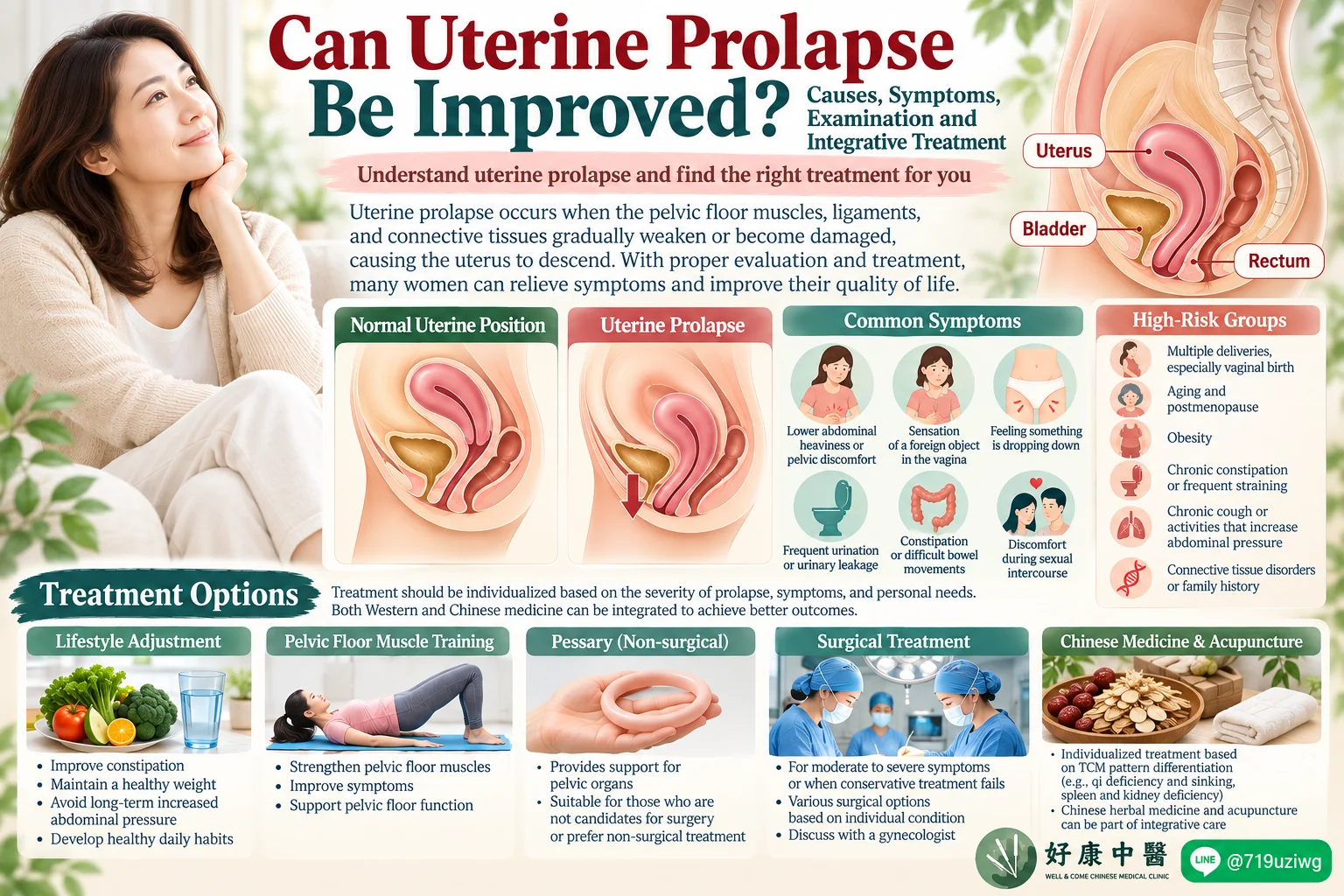
Many women notice a feeling of heaviness or pressure in the lower abdomen after childbirth or around menopause. Some describe a sensation of something being inside the vagina or even “something coming down.” These symptoms may be related to uterine prolapse, a form of pelvic organ prolapse.
Uterine prolapse is not simply a problem with the uterus itself. It occurs when the pelvic floor muscles, ligaments, fascia, and connective tissues that support the uterus and vagina become weakened or damaged, allowing the uterus to descend from its normal position.
Pregnancy and vaginal childbirth, increasing age, menopause, obesity, chronic constipation, and conditions that repeatedly increase intra-abdominal pressure may all contribute to the risk of pelvic organ prolapse [1][2].
From the perspective of Traditional Chinese Medicine (TCM), uterine prolapse is traditionally categorized under conditions such as “Yin Ting” (陰挺). Treatment is based on pattern differentiation, with patterns such as sinking of Qi and deficiency of the Spleen and Kidney commonly considered.
In addition to conventional approaches such as pelvic floor rehabilitation and pessary treatment, Chinese herbal medicine and acupuncture may be considered as complementary options after individualized assessment.
What Is Uterine Prolapse?
The uterus is located within the pelvic cavity and is normally supported by pelvic floor muscles, fascia, ligaments, and surrounding connective tissues.
When these supporting structures become weakened or damaged because of childbirth, aging, or prolonged increases in intra-abdominal pressure, the uterus may gradually descend toward the vaginal canal.
In mild cases, the uterus may simply sit lower than its normal position. In more advanced cases, the cervix or part of the uterus may protrude through the vaginal opening.
Medically, uterine prolapse is one type of pelvic organ prolapse (POP). Pelvic organ prolapse may also involve the bladder, vaginal walls, or rectum. This is why some women experience urinary or bowel symptoms in addition to pelvic pressure or a bulging sensation [1][3].
What Causes Uterine Prolapse? Who Is at Higher Risk?
Uterine prolapse usually does not result from a single cause. It often develops as pelvic floor damage and tissue degeneration accumulate over time.
Pregnancy and vaginal childbirth are important risk factors. During pregnancy, the increasing weight of the fetus and changes in intra-abdominal pressure place additional stress on the pelvic floor. Vaginal delivery may also stretch or injure pelvic floor muscles, fascia, connective tissues, and nerves, potentially affecting pelvic support later in life [1].
Age-related changes and menopause may further contribute to weakening of pelvic tissues.
Other factors such as obesity, chronic constipation with repeated straining, chronic coughing, and activities involving repeated heavy lifting may also increase pressure on the pelvic floor [1][3].
Women who have had multiple pregnancies or vaginal deliveries and who also have obesity, constipation, or chronic cough may therefore need to pay particular attention to pelvic floor health.
What Are the Symptoms of Uterine Prolapse?
Mild uterine prolapse may cause few or no symptoms, and some women only discover it during a gynecological examination.
As prolapse becomes more pronounced, symptoms may include:
A feeling of pressure or heaviness in the lower abdomen or pelvis, a foreign-body sensation in the vagina, or the feeling that something is protruding through the vaginal opening.
Some women notice that their symptoms become more obvious after prolonged standing, walking, or physical activity and improve after lying down or resting.
Other possible symptoms include frequent urination, urinary leakage, difficulty completely emptying the bladder, constipation, difficulty with bowel movements, and discomfort during sexual intercourse [3].
If tissue can already be felt or seen protruding from the vaginal opening, evaluation by a gynecologist or urogynecologist is recommended to determine the type and severity of prolapse rather than relying on symptoms alone.
Can Uterine Prolapse Improve on Its Own?
This is one of the most common questions women ask.
Uterine prolapse does not necessarily worsen continuously in every patient. According to the American College of Obstetricians and Gynecologists (ACOG), pelvic organ prolapse may remain stable or improve in some women. However, more severe prolapse is less likely to improve on its own [4].
Therefore, whether uterine prolapse can improve depends on more than the presence or absence of prolapse.
The severity of prolapse, symptoms, age, body weight, lifestyle factors, and pelvic floor function should all be considered.
For mild symptoms, initial management may include treating constipation, maintaining a healthy weight, managing chronic cough, and performing appropriate pelvic floor muscle exercises.
If prolapse interferes with urination, bowel movements, walking, or everyday activities, further evaluation for treatments such as a pessary or surgery may be appropriate [3].
Does Uterine Prolapse Always Require Surgery?
No.
Women with little or no discomfort may initially be managed with observation, lifestyle modification, and pelvic floor muscle training.
Pelvic floor physical therapy can help strengthen the relevant muscles and may improve symptoms in some women [3].
Another commonly used nonsurgical option is a pessary. A pessary is a device placed inside the vagina to provide additional support for the pelvic organs.
When prolapse is more severe, conservative treatments are insufficient, or symptoms significantly affect quality of life, surgical treatment may be considered.
The appropriate procedure depends on several factors, including the location and severity of prolapse, age, future pregnancy plans, sexual function, overall health, and individual treatment preferences [1][3].
How Does Traditional Chinese Medicine View Uterine Prolapse?
In Traditional Chinese Medicine, uterine prolapse has historically been discussed within the category of “Yin Ting” (陰挺).
Traditional Chinese medical theory associates the condition with factors such as depletion of Qi and Blood after childbirth, constitutional weakness, chronic illness, aging, Spleen Qi deficiency, and Kidney deficiency.
One commonly discussed pattern is Qi deficiency with sinking, in which the body’s ability to support and hold the internal organs in their proper position is considered weakened.
For this reason, TCM treatment does not simply aim to physically “lift the uterus.” Treatment is individualized according to the patient’s overall constitution, symptoms, and pattern differentiation.
Common therapeutic principles may include tonifying Qi, raising Yang, addressing sinking Qi, and supporting the Spleen and Kidney when appropriate.
Can Bu Zhong Yi Qi Tang Be Used for Uterine Prolapse?
Bu Zhong Yi Qi Tang (補中益氣湯) is a well-known Chinese herbal formula traditionally used for patterns involving Qi deficiency and sinking. However, it is not appropriate for every woman with uterine prolapse.
For example, a patient with a Qi-deficiency pattern may also experience fatigue, shortness of breath, a weak voice, reduced appetite, and a feeling of pelvic heaviness that becomes more noticeable after prolonged standing.
Other patients may present with Kidney deficiency, Blood deficiency, Yin deficiency, or mixed patterns, requiring a different treatment approach.
A Chinese clinical study investigated a modified Yi Qi Sheng Xian Tang (益氣升陷湯) combined with magnetic stimulation for uterine prolapse. The combined-treatment group showed better results than magnetic stimulation alone in certain clinical outcomes and pelvic floor muscle-strength measures [5].
However, studies of this type have limitations, including sample size, study design, and the need for independent external validation.
These findings therefore do not establish Chinese herbal medicine as a replacement for standard treatments such as pelvic floor rehabilitation, pessary therapy, or surgery when surgery is medically indicated.
Chinese herbal medicine is better considered as a potential component of individualized integrative care under professional supervision rather than as a treatment patients should prescribe for themselves.
Can Da Bu Yuan Jian Be Used for Postpartum Uterine Prolapse?
Qi deficiency with sinking is not the only pattern considered in Chinese medicine.
Some postpartum or older patients may present with signs that are interpreted as Kidney deficiency, in which case the treatment strategy may differ.
A 2025 article published in the Zhejiang Journal of Traditional Chinese Medicine investigated modified Da Bu Yuan Jian (大補元煎) combined with pelvic floor rehabilitation in women with postpartum uterine prolapse diagnosed with a Kidney-deficiency pattern.
From a TCM perspective, Da Bu Yuan Jian is generally used with the therapeutic principle of replenishing deficiency and supporting Kidney essence and Qi. Additional herbs may be selected according to the individual patient’s presentation.
This illustrates an important principle of Chinese medicine: uterine prolapse does not automatically correspond to one herbal prescription.
Whether treatment should focus on tonifying and raising Qi, supporting the Kidney, or addressing other patterns should be determined through individualized assessment.
Can Acupuncture Help Uterine Prolapse?
Acupuncture may also be used as a complementary treatment in TCM practice.
Commonly considered acupuncture points may include Guanyuan (CV4), Qihai (CV6), Zusanli (ST36), and Sanyinjiao (SP6), with additional points selected according to the patient’s symptoms and TCM pattern.
However, the current evidence for acupuncture in uterine prolapse is not as established as the evidence supporting standard approaches such as pelvic floor muscle training, pessary therapy, and surgery.
Acupuncture is therefore better considered as part of an integrative treatment plan rather than as a method that can be expected to anatomically restore severe uterine prolapse to its normal position.
How Can Uterine Prolapse Be Managed in Daily Life?
Daily habits are an important part of managing pelvic floor health.
Women with chronic constipation should work on improving dietary fiber intake, adequate fluid intake, and bowel habits to reduce repeated straining.
For those who are overweight, appropriate dietary and exercise strategies may help reduce stress on the pelvic floor. Chronic coughing should also be evaluated and treated appropriately.
Postpartum women and patients with mild prolapse may benefit from pelvic floor muscle training performed under professional guidance.
It is important to remember that pelvic floor exercises are not simply about squeezing as hard as possible.
Women who are unsure whether they are contracting the correct muscles may benefit from assessment by a gynecologist, urogynecologist, or pelvic floor physical therapist.
Frequently Asked Questions About Uterine Prolapse
Q1: Is uterine prolapse always caused by childbirth?
No. Pregnancy and vaginal childbirth are important risk factors, but aging, menopause, obesity, chronic constipation, chronic cough, and other conditions that repeatedly increase intra-abdominal pressure may also increase the risk of pelvic organ prolapse [1].
Q2: Can exercise improve uterine prolapse?
Appropriate pelvic floor muscle training may improve symptoms and pelvic floor function in women with mild prolapse. More severe prolapse, however, generally cannot be managed with exercise alone and may require evaluation for a pessary or surgical treatment.
Q3: Does uterine prolapse always require surgery?
No. Treatment depends on the severity of the prolapse and the symptoms it causes. Women with minimal symptoms may be monitored, while others may benefit from pelvic floor rehabilitation or a pessary. Surgery may be considered when symptoms are significant or conservative treatments are insufficient.
Q4: Can Chinese herbal medicine lift a prolapsed uterus back into place?
There is currently insufficient high-quality evidence to conclude that Chinese herbal medicine alone can restore severe uterine prolapse to its normal anatomical position.
TCM treatment may be individualized according to patterns such as Qi deficiency with sinking or Spleen and Kidney deficiency and may be considered as part of integrative care. It should not replace appropriate gynecological evaluation or medically indicated treatment.
Q5: Which is more suitable, Bu Zhong Yi Qi Tang or Da Bu Yuan Jian?
The two formulas have different traditional indications.
Bu Zhong Yi Qi Tang is more closely associated with Qi deficiency and sinking, while Da Bu Yuan Jian is generally considered in patterns involving Kidney deficiency and depletion of essence and Qi.
The appropriate prescription depends on the patient’s overall symptoms, constitution, tongue and pulse findings, and professional TCM assessment. Patients should not select an herbal formula solely because they have been diagnosed with uterine prolapse.
References
[3] Brown OE, Mou TP, Ackenbom MF. Uterine Prolapse. JAMA. 2023;330(15):1486–1487.